
MLB May Run Line Trend: Fading a Narrow Starter Volatility Setup

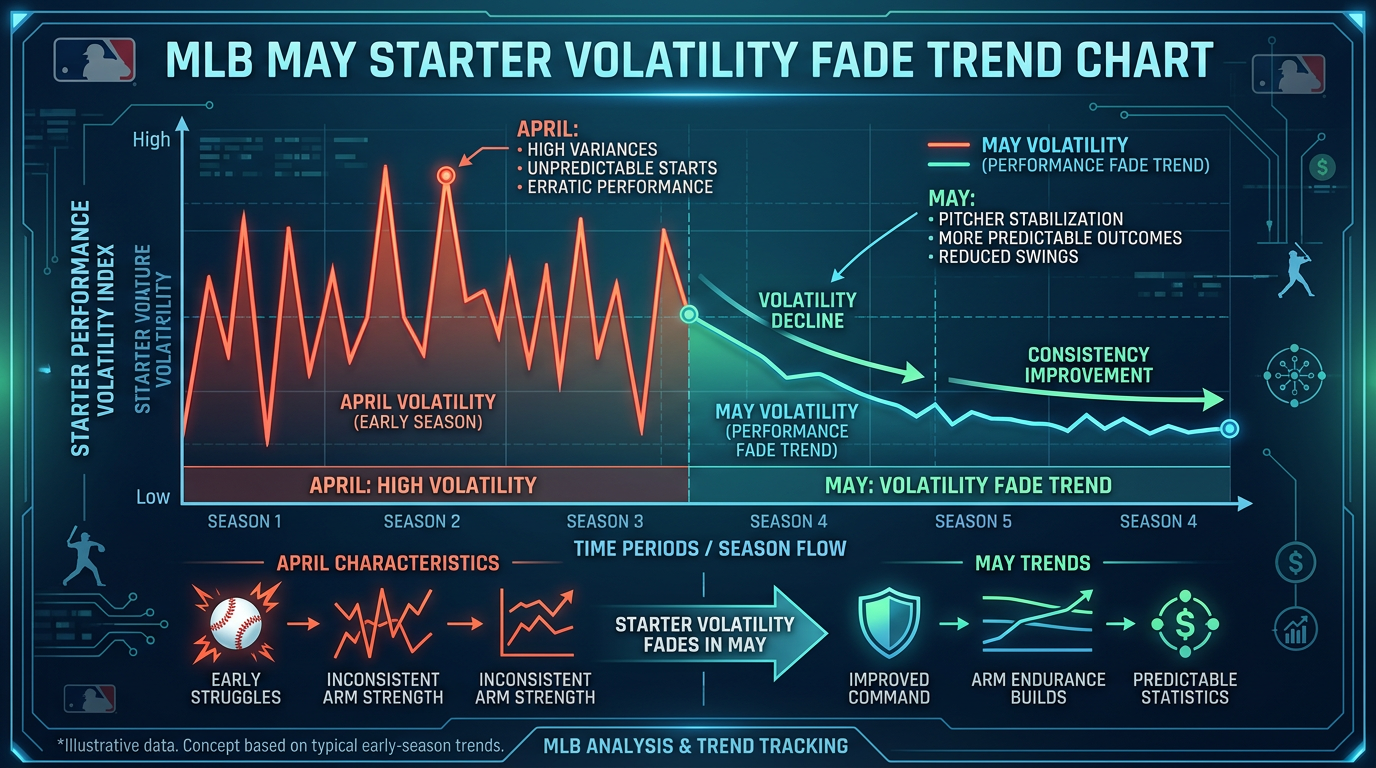
This MLB May run line trend identifies a very specific early-season setup built around starter volatility, opponent quality, and game-state pressure from the previous outing. The historical record is extreme: the qualifying side has gone just 2-19 straight up and 3-18 on the run line. That makes this a fade signal, not a play-on signal.
MLB May Run Line Trend: What the SDQL Query Is Measuring
This MLB May run line trend is based on the following SDQL query:
SDQL: os:times tied>=6 and month=5 and o:losses<=15
In plain English, this query looks for teams in May whose opponent fits a strong early-season profile, while the opponent’s starter is coming off a prior outing that involved at least six tie-game states.
That “times tied” condition is important because it points toward a previous start with repeated game-state pressure. A pitcher whose last outing repeatedly moved through tied-score situations may have been involved in a volatile, high-leverage game environment. The trend then combines that starter-context signal with a May opponent that has lost no more than 15 games.
The result is not a broad MLB betting angle. It is a narrow market filter.
The Historical Record
Here is the record for the qualifying side:
| Market | Record | Avg Margin | Win % | ROI | Profit | P-Value |
|---|---|---|---|---|---|---|
| Straight Up | 2-19 | -4.3 | 9.5% | -80.2% / +64.8% | -$1,966 / +$1,779 | 0.00011063 |
| Run Line | 3-18-0 | -4.4 | 14.3% | -72.0% / +66.7% | -$1,955 / +$1,730 | 0.00074482 |
The average prices were:
| Market Detail | Average Price |
|---|---|
| Average Moneyline | +100.1 / -123.9 |
| Average Run Line | -114.9 / -108.3 |
| Average Total | 8.7 |
Because the qualifying side is only 2-19 straight up and 3-18 on the run line, the betting value would have been on the opposite side of the query.
Why This MLB May Run Line Trend Is a Fade Signal
This MLB May run line trend should be interpreted as a fade because the qualifying side has failed badly in both markets.
Straight up, the qualifying team has won only:212=9.5%
On the run line, the qualifying team has covered only:213=14.3%
That means the fade side has gone:19−2 SU
and:18−3 RL
That is the important interpretation. The system is not saying these teams are attractive because of the filter. It is saying this specific filter has historically identified teams that were dramatically overmatched or poorly priced within this early-season context.
What the Market May Be Missing
The likely market logic is not that “times tied” is magical by itself. The stronger interpretation is that it may be catching a hidden volatility condition.
A starter coming off an outing with six or more tied-score states may have recently been involved in a game where control of the matchup repeatedly reset. That can reflect pressure, bullpen involvement, scoring instability, or game flow that was less clean than the final box score suggests.
When that condition appears in May, against an opponent with 15 or fewer losses, the market may not fully price the gap between a relatively stable opponent and a team entering a vulnerable spot.
The result has been severe underperformance by the qualifying side.
Small Sample Warning
This is a very strong historical record, but it is also a very small sample.
A 21-game sample should never be treated the same way as a 500-game trend. The P-values are low, and the performance is extreme, but the sample size means this should be used as a supporting market signal rather than a standalone betting system.
The correct takeaway is:Strong Signal=Automatic Bet
This trend is useful because it identifies a rare setup worth monitoring. It should still be checked against price, pitching quality, lineup strength, bullpen availability, weather, and broader market movement.
How to Use This Trend in Practice
The practical use of this MLB May run line trend is to flag games where the qualifying team may be vulnerable on both the moneyline and run line.
The fade side has historically performed better in both markets:
| Fade Market | Fade Record | Fade Win % | Fade ROI |
|---|---|---|---|
| Moneyline Fade | 19-2 | 90.5% | +64.8% |
| Run Line Fade | 18-3 | 85.7% | +66.7% |
The run line result is especially notable because the average run line price on the fade side was only -108.3. At that price, the break-even point is roughly:108.3+100108.3=52.0%
The historical fade side covered 85.7%, which is far above the required break-even rate. Again, the sample is small, but the gap between required win rate and historical performance is large enough to justify tracking.
Why May Matters
May is a useful month for MLB systems because the market is no longer working with no information, but it is still early enough for perception gaps to exist.
By May, teams have built partial-season records. Bettors begin forming opinions around hot starts, poor starts, early pitching form, and team quality. However, the sample is still incomplete. That creates room for pricing errors when a team’s current record does not fully reflect its underlying strength or weakness.
This trend uses the condition o:losses<=15 to isolate opponents that have not been losing heavily to that point in the season. That gives the setup a quality-control filter rather than treating every May game equally.
Betting Interpretation
The cleanest interpretation is:
This is a May MLB fade trend against teams facing relatively stable opponents when the opposing starter’s previous outing included repeated tied-score pressure.
The qualifying team has been bad straight up. It has also been bad against the run line. That makes the run line side especially interesting because a team losing by an average of 4.3 runs is not merely losing close games.
The average cover margin of -4.4 on the run line suggests the qualifying side has not just failed to win. It has often failed to stay competitive.
Final Takeaway
This MLB May run line trend is a narrow but powerful fade setup. The qualifying team is only 2-19 straight up and 3-18 on the run line, while the opposite side has produced strong historical ROI in both markets.
The most responsible use is not to blindly bet every qualifier. The better use is to treat the trend as a high-priority flag inside a larger handicapping and market-analysis process.
When the current number, starting pitcher matchup, bullpen situation, and market movement also support the fade side, this trend becomes much more meaningful.
How This Fits Into the Market
This trend fits into broader sports betting market mechanics because it shows how narrow database filters can identify conditions the public market may not price efficiently.
It also connects directly to public bias and market distortion. The market may focus on surface-level team record, starting pitcher name value, or recent box-score outcomes while missing deeper game-state volatility.
That is why sports betting systems should be treated as structured market signals, not predictions. A system does not know the future. It identifies historical conditions where the market may have repeatedly mispriced risk.
Process & Proof
This type of MLB trend analysis works best when paired with documented betting results and long-term tracking. Isolated systems can look impressive, but the real edge comes from building a repeatable process and measuring results over time.
For members, Raw Numbers can help place these trends into a larger daily betting context by comparing system signals, pricing, market position, and matchup structure before deciding whether a game deserves action.
Related Analysis
For more MLB-specific system work, see the broader MLB team trends page.
For a totals-based MLB SDQL example, see the MLB Under SDQL trend on market overreaction after offensive collapse.
For early-season MLB market behavior, see the MLB Opening Day systems analysis.

Starter volatility is such an underrated factor early in the MLB season. A pitcher can look completely different from one outing to the next in May, and it feels like the market sometimes overreacts to the most recent start.
Good trend breakdown. I like the focus on run line value instead of just trying to pick the winner.
That distinction matters a lot in MLB. The best team or starter does not always create the best betting opportunity. Run line value depends on price, margin expectation, and whether the market has overreacted to recent pitching performance.
Starter volatility in May makes a lot of sense. Pitchers are still settling in, and the market can overreact quickly to one good or bad outing.