
Favorites vs High-Loss Opponents NBA ATS Trend

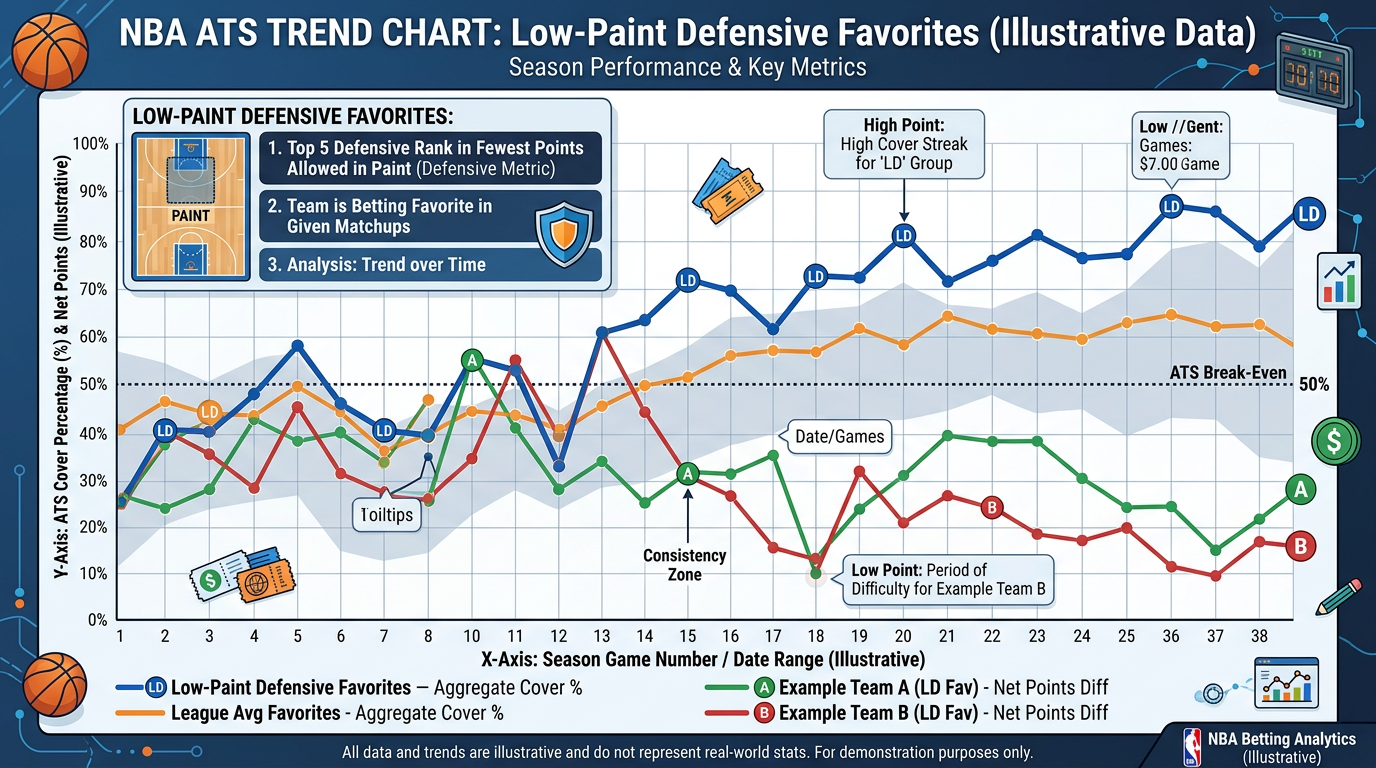
This NBA ATS trend identifies favorites facing weaker opponents late enough in the season for loss count to matter. The setup combines opponent weakness with a prior defensive/interior-scoring condition: the team’s last opponent scored fewer than 40 points in the paint. Historically, this has produced a strong straight-up record and a profitable ATS edge.
NBA ATS Trend: What the SDQL Query Is Measuring
SDQL: po:points in the paint<40 and F and o:losses>=37
In plain English, this NBA ATS trend looks for teams that meet three conditions:
- Their previous opponent scored fewer than 40 points in the paint
- They are favored in the current game
- Their current opponent has lost at least 37 games this season
This is a play-on favorite trend. The system is not trying to find an underdog or a contrarian fade spot. It is looking for favorites that may be positioned well against weak opponents after recently playing in a game where their previous opponent failed to generate much interior scoring.
The key logic is that this trend combines current opponent weakness with recent defensive game-state context.
The Historical Record
| Market | Record | Avg Cover Margin | Win % | ROI | Profit | P-Value |
|---|---|---|---|---|---|---|
| Straight Up | 1717-518 | +8.2 | 76.8% | — | — | 0.00000000 |
| ATS | 1185-1002-48 | +0.4 | 54.2% | +3.4% / -12.5% | +$8,280 / -$30,150 | 0.00004933 |
Average market conditions:
| Market Detail | Average |
|---|---|
| Average Line | -7.7 |
| Average Total | 201.4 |
The straight-up record is strong, but that is expected because every team in the query is a favorite. The more important result is the ATS record.
Why This NBA ATS Trend Matters Against the Spread
This NBA ATS trend is meaningful because it clears the break-even threshold against the spread over a large sample.
At standard -110 pricing, the approximate break-even win rate is:110+100110=52.38%
This trend has covered at:1185+10021185=54.2%
That gap may look small, but across more than 2,100 graded ATS decisions, it is meaningful. Sports betting edges are usually not huge. A long-term ATS system that wins 54.2% against a standard market is materially different from random noise, especially when supported by a low P-value.
The average cover margin is only +0.4 points, so this is not a blowout-only trend. It is a modest but persistent market edge.
Why the Paint-Scoring Filter May Matter
The condition po:points in the paint<40 is the most interesting part of the query.
Points in the paint are a useful basketball signal because they often reflect shot quality, rim pressure, defensive resistance, and offensive physicality. When a team’s previous opponent scored fewer than 40 points in the paint, it may indicate that the team recently played in a game where interior defense, pace control, or shot profile tilted away from easy basket creation.
That does not automatically mean the team is a great defensive team. It also does not mean the next matchup will repeat the same exact conditions.
But as a historical filter, it may be identifying favorites coming out of a cleaner defensive environment than the market fully accounts for.
When that favorite then faces a team with at least 37 losses, the setup becomes more focused. The system is not merely asking whether favorites cover. It is asking whether favorites with this specific prior-game context perform well against opponents that have already shown sustained weakness.
Why Opponent Loss Count Matters
The condition o:losses>=37 filters for opponents that have lost at least 37 games.
That usually means the opponent is not just temporarily struggling. It often points to a team with deeper season-long issues: poor roster quality, weak defense, limited depth, injuries, poor late-season motivation, or some combination of those factors.
By this stage of the season, the market already knows the opponent is bad. The question is whether the line fully prices how bad the opponent is in this specific matchup context.
This NBA ATS trend suggests that the market has historically underpriced these favorites slightly.
The Favorite Problem: Why This Is Not Automatic
Because the average line is -7.7, this trend is dealing with relatively meaningful favorite prices.
That matters. Favorites can win comfortably and still fail to cover. A favorite laying -7.5 must not only be the better team, but must also maintain margin across four quarters. Late backdoor covers, garbage-time rotations, and pace changes can all damage ATS results.
That is why the ATS record is more important than the straight-up record.
The system has gone:1717−518 SU
but the real betting result is:1185−1002−48 ATS
The straight-up record confirms these teams usually win. The ATS record confirms that they have also beaten the market often enough to create a documented historical edge.
Market Interpretation
The betting market may understand that these teams should be favored, but not fully adjust for the combination of opponent weakness and recent interior-control context.
This is the likely market logic:
A favorite is facing a team with 37 or more losses. The public may already assume the favorite should win, so the line rises. However, the system still shows ATS profitability, meaning the historical line has not fully erased the value.
That is important because many favorite-based systems fail once the market inflates the number. This one has still produced a 54.2% ATS cover rate despite an average spread of -7.7.
How to Use This NBA ATS Trend
The best use of this trend is as a supporting signal, not a blind betting command.
Before using it, I would still check:
- Current injury reports
- Rest situation
- Rotation motivation
- Line movement
- Closing line value potential
- Whether the favorite is still priced reasonably
- Whether the high-loss opponent is tanking, injured, or simply undervalued
The trend is strongest when the current matchup also supports the historical logic. If the favorite is healthy, motivated, and not laying an inflated number, this setup becomes more useful.
If the spread has already moved aggressively, the edge may be reduced.
Final Takeaway
This NBA ATS trend identifies favorites facing teams with at least 37 losses after a prior-game setup where the team’s previous opponent scored fewer than 40 points in the paint.
The historical results are strong:1717−518 SU 1185−1002−48 ATS
The 54.2% ATS win rate, +3.4% ROI, and low P-value make this a legitimate system to track. It is not a massive-margin angle, but it does show a repeatable edge across a large sample.
The most responsible interpretation is that this is a play-on favorite signal when price, injuries, motivation, and market movement also support the side.
How This Fits Into the Market
This trend fits into broader sports betting market mechanics because it shows how a favorite can still carry value even when the market already knows the opponent is weak.
It also connects to public bias and market distortion because bettors often oversimplify favorite pricing. Some favorites are overpriced. Others remain underpriced because the market does not fully account for matchup context.
That is why sports betting systems should be treated as structured market signals, not guarantees.
Process & Proof
Long-term betting performance depends on repeatable process, not isolated predictions. This NBA ATS trend is useful because it can be documented, retested, and compared against market price over time.
For broader performance context, see the documented betting results page. For daily market-based projections and matchup data, members can also review the Raw Numbers dashboard.
Related Analysis
For a broader explanation of how betting systems should be interpreted, see What Sports Betting Systems Really Measure.
For a market-based guide to public behavior, see Why the Public Loses at Sports Betting.
For price and timing context, see Closing Line Value Explained.

I like the points-in-the-paint angle here. If a team just held or faced an opponent with limited interior production, that seems like a useful clue about matchup control instead of just looking at final score.
Correct. Final score only tells part of the story.
Points in the paint can help show whether a team was controlling the type of shots being created. When that connects with a favorite facing a high-loss opponent, it can point to a matchup where the favorite has more control than the spread may imply
The ATS part is important here. A favorite winning the game is obvious in a lot of these matchups, but the real question is whether the market is still underestimating the margin.
Exactly. Straight-up expectation and ATS value are two different things.
The market already knows the favorite is more likely to win. The edge only exists if the expected margin is still being mispriced. That is why this type of trend has to be tested against the spread, not just straight-up results.
The high-loss opponent filter makes sense. At some point, a bad team is not just having a rough stretch — the market has enough evidence that the team has structural problems.
That’s the idea. A high loss count tells us the weakness is not just one bad week or one bad matchup.
When a team has lost that many games, the market may still price individual matchups too generously if the line looks uncomfortable. The system is looking for situations where the favorite has enough quality separation to justify the number
I appreciate that this doesn’t just say ‘bet good teams against bad teams.’ The extra filters are what make it more interesting, because otherwise the market would already know who the better team is.
That’s the important distinction.
The market does not need help identifying good teams and bad teams. The value comes from isolating a more specific situation where the favorite’s role, opponent weakness, and recent matchup indicators line up. That is where SDQL becomes useful.
This is a good reminder that not every favorite is automatically overpriced. If the opponent has already lost that many games, the market may still not fully account for how weak the matchup really is.
Exactly. Favorites can be overpriced, but they are not always overpriced.
The key is the specific condition. This trend is not saying to blindly lay points with every favorite. It is identifying a spot where the opponent profile has been weak enough that the favorite role has historically still carried ATS value.
This article makes me think about how bad teams can keep being overvalued simply because the spread looks ugly. Bettors don’t want to lay the points, even when the matchup says the favorite deserves it.
That happens often. The number can look uncomfortable even when it is still justified.
Public bettors often prefer taking points with bad teams because it feels safer. But if the opponent lacks scoring consistency, defensive resistance, or late-game competitiveness, those points may not be worth as much as they appear.
This feels like a good example of using trends as a filter instead of a final answer. The system points to a profitable historical setup, but you still have to check injuries, current line, and whether the market already adjusted.
Exactly. A trend should never replace current market analysis.
The system identifies a condition that has mattered historically. From there, you still need to evaluate the current number, roster context, timing, and market movement. That is the difference between using SDQL as research and blindly following a backtest.
The biggest takeaway for me is that favorites can still have value when the opponent is weak enough. I usually think of value as taking points, but this shows price inefficiency can exist on either side.
Correct. Value is not tied to underdogs or favorites. It is tied to price.
Sometimes the dog is inflated because bettors want the points. Sometimes the favorite is still cheap because the line looks too high emotionally. The side does not matter as much as whether the market has priced the matchup correctly.