
NBA ATS Picks: Revenge Favorite Betting Trend

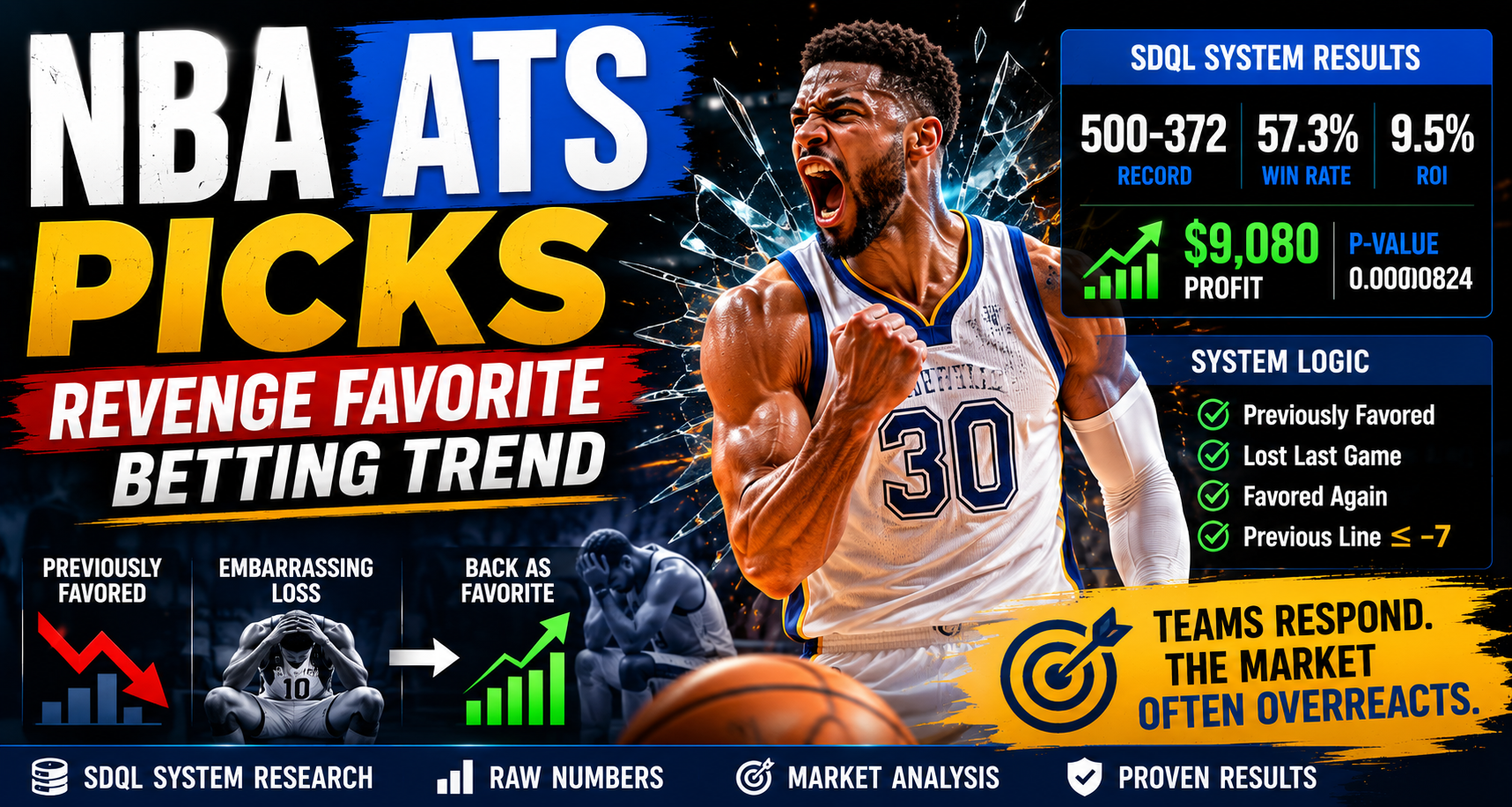
NBA ATS picks become more useful when they are supported by market context instead of emotional storylines. This SDQL betting trend looks at NBA favorites in revenge-style spots after embarrassing losses, showing how price, prior expectations, and market reaction can create a structured against-the-spread signal.
What Is This NBA Revenge Favorite Trend?
This NBA ATS trend focuses on favorites after a previous favorite loss. The core idea is that the market may adjust after an embarrassing result, but certain strong teams can still retain ATS value in the next qualifying spot.
SDQL:P:FL and p:L and F and P:line<=-7
Betting Market:
Against the Spread
System Direction:
Play the favorite ATS
Historical Results:
500-372
57.3%
9.5% ROI
$9,080 profit
P-value: 0.00000824
This is one of the stronger ATS systems in the current NBA research set because it combines a clear betting role with a logical market explanation.
The team was previously favored, lost, and is now favored again. The prior line was -7 or higher, meaning the earlier market expected that team to win comfortably. When a team loses in that type of spot, bettors may downgrade it emotionally.
That creates the key question behind this article:
Does the market sometimes overreact to a strong favorite’s embarrassing loss?
Historically, this system suggests the answer can be yes.
Why Revenge Spots Are Dangerous Without Data
Revenge is one of the most overused betting angles in sports. Bettors often assume a team will be motivated after a bad loss, but motivation alone is not enough to create value.
The phrase “revenge game” gets used too loosely.
A team may want revenge. A coach may be angry. Players may say the right things before the next game. But none of that matters unless the betting line still leaves value.
That is why this system is useful.
It does not simply say:
“Bet teams that want revenge.”
It tests a more specific condition:
- The team was previously expected to win.
- The team lost.
- The team is favored again.
- The previous favorite price was significant.
- The current setup has historically performed well ATS.
That turns a vague narrative into a measurable NBA betting trend.
How Should Bettors Read the SDQL Query?
The SDQL query identifies NBA teams that lost as favorites and are now favored again, with the previous favorite role strong enough to imply a meaningful expectation failure.
The query is:
P:FL and p:L and F and P:line<=-7
In plain English, this means:
- P = the team’s previous matchup was a favorite loss
- p = the team lost its previous game
- F = the team is favored in the current game
- P<=-7 = the previous line showed the team was a favorite of at least seven points
That is not a generic bounce-back system. It is a specific profile for teams that failed in a spot where the market expected a strong result.
The betting logic is straightforward: when a team loses as a sizable favorite, the public often remembers the embarrassment. But the next line may not fully reflect the difference between one bad result and the team’s broader market strength.
What Do the Results Say?
The system has gone 500-372 against the spread, winning 57.3% with a 9.5% ROI and $9,080 in historical profit. The p-value of 0.00000824 makes it one of the stronger revenge-style NBA ATS systems in the file.
The key results:
- Record: 500-372
- Win Rate: 57.3%
- ROI: 9.5%
- Profit: $9,080
- P-value: 0.00000824
- Sample Size: 872 decisions
Those results are strong enough to make this a standalone NBA betting trend.
The most important point is not that every favorite after an embarrassing loss should be bet blindly. The important point is that this profile has historically produced value when the current number still supports the favorite.
Why Embarrassing Favorite Losses Can Create ATS Value
Embarrassing favorite losses can create ATS value because the market may react too strongly to one bad result. A team can lose as a large favorite without becoming a bad team.
One game can change perception quickly.
A favorite loses outright. Bettors feel burned. Media coverage focuses on the upset. Fans question the team’s focus, toughness, or coaching. Public confidence weakens.
But sportsbooks still have to price the next game.
That creates a tension between public memory and underlying team quality.
A strong team that loses as a big favorite may still be strong. The loss may have been driven by poor shooting, turnovers, rest, injuries, matchup variance, or late-game randomness. The result matters, but it may not justify a full downgrade.
This system attempts to capture situations where the prior loss affects perception more than true betting value.
Why the Favorite Role Matters
The favorite role matters because this system is not built around underdogs trying to surprise the market. It is built around teams the market still respects enough to price as favorites again.
That detail is important.
If a team loses badly and is then priced as a large underdog, the market may be telling a very different story. But if the team is favored again, oddsmakers are still signaling that the team has meaningful strength.
The system is asking:
Is this team still strong enough to justify favorite pricing after the prior loss?
Historically, the answer has often been yes in this tested profile.
That is why this article fits the NBA ATS picks and NBA favorite picks keyword lanes. It is not just about revenge. It is about how the market prices a favorite after a public failure.
Supporting Revenge Favorite Systems
The broader NBA research file includes several related systems that support the same general theme: certain favorites have historically responded well ATS after ugly or unexpected losses.
Medium-to-Large Road Favorites Revenging Upset Home Losses
SDQL:A and P:HLF and line<-4.5
Historical Results:
323-226
58.8%
12.3% ROI
$7,440 profit
P-value: 0.00002004
This version adds a road favorite condition. The team had previously lost at home as a favorite and is now laying points away from home.
That is a stronger market signal than it may first appear.
If a team is still favored by more than 4.5 points on the road after losing as a home favorite, the market is continuing to rate that team highly. The historical results suggest that this type of setup deserves attention.
Big Favorites After Upset Losses
SDQL:p:L and p:line<=-12 and game number>22
Historical Results:
136-73
65.1%
24.2% ROI
$5,570 profit
P-value: 0.00000783
This is a smaller sample, but the ROI and win rate are very strong.
The logic is similar: when a team loses as a very large favorite, the result is memorable. But that does not always mean the team was overrated. Sometimes it creates a short-term market reaction that can be useful in the next qualifying spot.
Because the sample is smaller, this system should be used as supporting evidence rather than the entire foundation of the article. Still, it strengthens the revenge favorite cluster.
How Raw Numbers Fit Into This NBA ATS Trend
Raw Numbers help determine whether the current spread still supports the favorite after the revenge system qualifies. The historical trend identifies the setup, but the current number decides whether value remains.
This is where the process becomes practical.
A revenge favorite system can point to a possible opportunity. But the betting decision still depends on the current board.
When a current NBA game qualifies for this trend, the next questions should be:
- Does Raw Numbers support the favorite?
- Is the current spread still playable?
- Did the line already move too far?
- Was the previous loss misleading?
- Are injuries or rest issues involved?
- Is the market overreacting to the prior result?
- Does the favorite still have matchup advantages?
That is how a revenge angle becomes part of a disciplined NBA picks process.
Raw Numbers
Daily market projections and betting data used to support data-driven sports betting picks.
When This Trend May Be Stronger
This trend may be stronger when the previous loss created public doubt, but Raw Numbers, team quality, market pricing, and current matchup context still support the favorite.
The best version of this setup usually has multiple signals working together:
- The previous loss was embarrassing or unexpected
- The team is still favored in the current game
- Raw Numbers support the favorite
- The current line has not moved too far
- Injury context is stable
- The opponent is being overvalued
- The favorite has a clear matchup or market advantage
That kind of alignment is more important than the revenge label itself.
The system identifies the profile. The current market tells whether the pick still has value.
When This Trend May Be Weaker
This trend may be weaker when the favorite is overpriced, the previous loss exposed a real problem, the injury report has changed, or the market has already corrected aggressively toward the favorite.
Not every bounce-back spot is playable.
Sometimes a team loses as a big favorite because the market was wrong. Sometimes the roster is injured. Sometimes the matchup is bad. Sometimes the coach adjusts poorly. Sometimes the current favorite price is too high.
The biggest risk is assuming that “embarrassed team” automatically means “good bet.”
It does not.
The better approach is to treat the system as a filter, then evaluate whether the current spread still makes sense.
Main risks include:
- Inflated favorite pricing
- Public bounce-back betting
- Injury or rest problems
- A prior loss that revealed a real matchup issue
- Line movement that removes value
- Overconfidence in a small revenge narrative
That is why this system belongs inside a broader NBA betting process.
Why This Matters for NBA ATS Picks
NBA ATS picks require more than knowing which team is better. The spread already prices team strength, location, injuries, rest, and public expectation.
The value comes from finding where that price is wrong.
Revenge spots can matter, but only when the market reaction creates a pricing opportunity.
This system is useful because it turns a common betting narrative into a more specific historical test. Instead of saying “teams bounce back after bad losses,” it focuses on favorites that lost after being expected to win comfortably and are now favored again.
That is a more disciplined way to study revenge in NBA betting.
How This Fits With NBA Picks Today
This revenge favorite trend can support NBA picks today when it appears on the current board and agrees with Raw Numbers, line movement, injury context, and price discipline.
The practical workflow should look like this:
- Review the NBA betting board
- Check Raw Numbers for spread value
- Identify qualifying SDQL systems
- Review recent results and market perception
- Compare opening line to current line
- Check injuries, rest, and lineup context
- Decide whether the current number is still playable
When this system qualifies, it can move a game higher on the watch list. But it should not override price, injuries, or market movement.
NBA Picks Today Backed by Raw Numbers
The main NBA picks hub explaining how Raw Numbers, SDQL systems, and market analysis fit together.
How This Compares to the Road Favorite Trend
The previous NBA ATS article focused on road favorites facing opponents coming off close wins. This article focuses on favorites after embarrassing losses. Both are ATS systems, but they attack different market reactions.
The road favorite trend studies how the market treats an opponent after a close win.
This revenge favorite trend studies how the market treats a favorite after a bad loss.
Both systems are built around perception.
One looks at possible overvaluation after a narrow win. The other looks at possible overreaction after an ugly favorite loss.
Together, they strengthen the NBA ATS content cluster and create natural internal links across the series.
NBA Picks Against the Spread: Road Favorite Betting Trend
A data-driven NBA ATS system focused on road favorites facing opponents coming off close wins.
NBA Over Picks: High-Total Betting Trend
A data-driven NBA totals system focused on high-total Over value before the All-Star break.
Related NBA Analysis
Use these NBA pages to connect this trend to the broader NBA betting research structure.
NBA Trends
NBA betting trends, systems, and historical market analysis.
NBA Team Trends
Team-specific NBA betting trends and market-based research.
NBA Raw Numbers Example
A closer look at how NBA Raw Numbers can be used to evaluate the betting board.
How This Fits Into the Market
NBA spreads are market prices. They move because sportsbooks, public bettors, professional bettors, injury news, and recent results all interact.
These supporting guides explain the broader market framework behind NBA ATS picks:
Sports Betting Market Mechanics
How line movement, timing, sharp money, and market pricing work.
Public Bias and Market Distortion
How public perception can distort betting prices and create value.
What Sports Betting Systems Really Measure
How systems should be used as market signals instead of isolated betting shortcuts.
Process & Proof
A serious NBA ATS betting process should be measurable over time. That is why ProComputerGambler emphasizes Raw Numbers, documented results, and long-term performance tracking.
Raw Numbers
Daily betting projections and market data used to support the picks process.
Historical Performance
Long-term documented results and performance transparency.
Sports Betting Picks Subscription
Member access to daily sports betting picks, Raw Numbers, and betting analysis.
Final Thoughts on This NBA Revenge Favorite Trend
This NBA ATS picks system is valuable because it studies a familiar betting idea through a more disciplined lens. Revenge alone is not enough. Motivation alone is not enough. A prior embarrassing loss is not enough.
The useful question is whether the market has mispriced the next game.
Historically, NBA favorites in this tested profile have produced strong ATS results. The system deserves attention when it appears on the board, especially when Raw Numbers, current price, line movement, and injury context support the same side.
That is the foundation of a stronger NBA ATS picks process: not chasing revenge narratives, but identifying where the market may have reacted too far.
