
NBA Under Picks: Rebound and Turnover Betting Trends

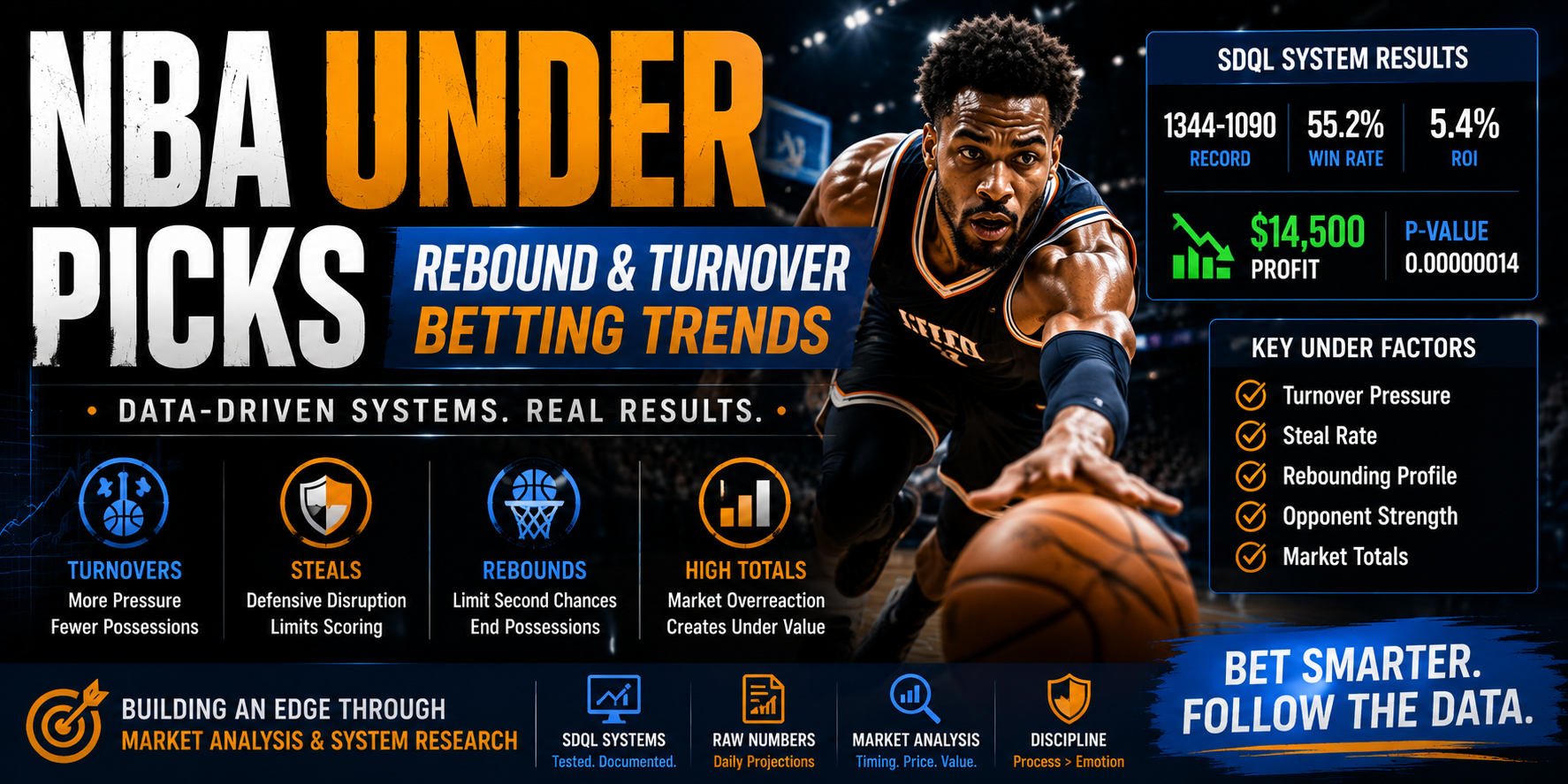
NBA under picks require more than simply fading high-scoring teams or betting against popular Overs. This article studies several SDQL-based NBA Under systems tied to turnovers, steals, rebounding profiles, opponent quality, and market totals, showing how possession quality can shape a more disciplined NBA totals betting process.
What Are These NBA Under Betting Trends?
These NBA Under trends focus on possession disruption, turnover pressure, rebounding limits, opponent quality, and prior-game context. The strongest systems in this group show that Unders can be supported by more than pace alone.
The current NBA research file includes several Under systems worth grouping together because they all point toward a similar market idea: totals are not only about how fast teams play or how many points they scored recently.
A strong Under profile may also come from:
- Turnovers
- Steals
- Reduced shot volume
- Limited second-chance opportunities
- Stronger defensive pressure
- Rebounding profiles
- Market totals that are already elevated
- Opponent strength and prior-game conditions
That is why this article focuses on the connection between possessions, shot quality, rebounds, and turnovers.
Featured NBA Under System: Steals and Turnover Pressure
This NBA Under system focuses on games involving opponent steals, team winning percentage, and previous opponent turnover behavior. Historically, it has produced a large sample with positive Under results.
SDQL:season>=2015 and op:steals>10 and WP>30.0 and po:turnovers>12
Betting Market:
Over / Under
System Direction:
Play the Under
Historical Results:
1344-1090
55.2%
5.4% ROI
$14,500 profit
P-value: 0.00000014
This is the strongest lead system for the article because it combines a large sample with a clear basketball explanation.
The system is not just saying “bet Unders when teams turn the ball over.” It is looking at a specific profile involving opponent steals, team quality, and previous turnover behavior.
The logic is that turnover pressure can reduce clean offensive possessions. Even if pace is reasonable, poor possession quality can keep scoring below the market number.
That matters because many NBA totals bettors focus too heavily on pace and recent scoring averages. Pace creates opportunities, but turnovers and steals can destroy those opportunities before they become high-quality shots.
Why Do Turnovers Matter for NBA Under Picks?
Turnovers matter for NBA Under picks because they can reduce shot volume, interrupt offensive rhythm, and create empty possessions. A game can move quickly and still stay Under if too many possessions end without clean attempts.
Pace alone can be misleading.
A fast game with clean possessions, efficient shooting, and limited turnovers can push toward the Over. But a fast game with sloppy ball handling, defensive pressure, and poor half-court execution can still stay below the total.
That is why turnovers are so important in NBA totals analysis.
Every turnover can remove:
- A shot attempt
- A potential assist
- A chance at free throws
- A second-chance opportunity
- A rhythm-building possession
Some turnovers lead to transition points the other way, so they are not automatically Under-friendly. But when the broader profile points toward pressure, disruption, and lower-quality possessions, turnovers can become part of an Under signal.
The key is context.
This system is not using turnovers in isolation. It combines turnovers with opponent steals and team-quality filters, which makes it more useful than a simple “high turnovers equal Under” assumption.
Supporting NBA Under System: Rebounding Profile
Another strong NBA Under system in the research file is based on offensive rebounds, defensive rebounds, and opponent winning percentage. This points toward the role of second-chance points and possession extension.
SDQL:P:offensive rebounds<=7 and o:WP>=50.0 and P:defensive rebounds<=32
Betting Market:
Over / Under
System Direction:
Play the Under
Historical Results:
2051-1731
54.2%
3.5% ROI
$14,690 profit
P-value: 0.00000011
This system has an even larger sample than the turnover-pressure system. The ROI is lower, but the sample size and p-value make it useful as a supporting trend.
The logic is different but related.
Offensive rebounds extend possessions. Defensive rebounds end possessions. When a team has limited offensive rebounding and a controlled defensive rebounding profile, the game may have fewer extended scoring sequences.
Second-chance points are an important part of NBA totals.
A missed shot does not always end the possession. Offensive rebounds create extra shots, fouls, kick-out threes, and scramble situations. If those extra possessions are limited, the total may have less room to climb.
That is why rebound-based Under systems can be useful.
Why Rebounds Can Influence NBA Totals
Rebounds influence NBA totals because they determine whether possessions end cleanly or continue into extra scoring chances. Offensive rebounds can push games Over, while limited second-chance opportunities can support Unders.
A possession is not just about the first shot.
An NBA team can miss the initial attempt and still score if it controls the offensive glass. Those extra possessions often create some of the most efficient scoring chances in basketball because the defense is out of position.
Rebounding can affect totals through:
- Second-chance points
- Extra three-point attempts
- Putbacks
- Fouls after offensive rebounds
- Extended possessions
- Defensive fatigue
- Late-clock resets
When a system identifies teams with limited offensive rebounding or lower possession-extension profiles, it can point toward Under value.
This does not mean all poor rebounding teams should be bet Under. But it does mean rebounding context belongs in NBA totals analysis.
Supporting NBA Under System: Elevated Total Environment
A third supporting Under system focuses on teams coming off wins, modest line ranges, and opponents with high average total environments. This adds a market-pricing layer to the totals discussion.
SDQL:P:line>-2.5 and p:W and oA(total)>=227.19
Betting Market:
Over / Under
System Direction:
Play the Under
Historical Results:
1027-878
53.9%
2.9% ROI
$6,120 profit
P-value: 0.00034639
This system is not as strong as the first two, but it is still useful because it brings in a different kind of totals logic.
The market may already know the opponent is playing in higher-total environments. When that information becomes obvious, bettors may lean toward the Over too easily. The Under can become interesting if the current situation does not fully support the inflated scoring expectation.
This is a more subtle system.
It does not have the eye-catching ROI of the turnover-pressure system, but it helps explain why NBA totals should be evaluated through price, context, and market expectation rather than raw scoring averages alone.
Why High Totals Can Still Create Under Value
High totals can create Under value when the market overprices scoring expectations. A game can involve strong offenses or recent high-scoring profiles and still be priced too aggressively.
This is the opposite side of the earlier NBA Over article.
In that article, the lesson was that a high total does not automatically mean the Over is overpriced. Here, the lesson is slightly different: a high scoring environment does not automatically justify every elevated total.
Both ideas can be true.
The difference is the specific profile.
A high total can go Over if the market has not fully captured the scoring environment. A high total can go Under if the market has overreacted to recent scoring, public preference, or offensive reputation.
That is why NBA over under picks need to be system-specific.
Broad opinions like “high totals are inflated” or “NBA scoring is up, bet Overs” are too simple. The better approach is to test specific conditions and compare them to current Raw Numbers.
How Raw Numbers Fit Into NBA Under Picks
Raw Numbers help compare the current posted total against baseline projections. For NBA under picks, they can show whether the market number is above the expected scoring environment before a system is considered actionable.
This is where historical research and current data work together.
A historical Under system tells us that a certain type of NBA game has produced Under value in the past. Raw Numbers help determine whether today’s posted number still leaves room for that edge.
When an NBA Under system qualifies, the next questions should be:
- What is the current posted total?
- What was the opening total?
- Has the market moved toward the Under or Over?
- Does the Raw Numbers projection support the Under?
- Are there injury or lineup changes affecting scoring?
- Is the pace expectation realistic?
- Does the rebounding or turnover profile still apply?
- Has the number already moved too far?
That process matters because the same Under can be valuable at one number and weak at another.
Raw Numbers
Daily market projections and betting data used to support data-driven sports betting picks.
Why NBA Totals Require More Than Pace
NBA totals require more than pace because pace measures possession volume, not possession quality. Turnovers, shot selection, offensive rebounding, free throws, and defensive pressure all affect whether possessions become points.
Pace is useful, but it is not enough.
A team can play fast and inefficiently. Another team can play slower but score efficiently. A fast game with turnovers may stay Under. A slower game with elite shooting and free throws may go Over.
That is why totals betting should separate:
- Possession volume
- Possession quality
- Shot profile
- Rebounding
- Turnovers
- Free throws
- Market price
- Injury context
The Under systems in this article are useful because they focus on areas that are often missed by casual totals bettors.
Many bettors see NBA totals through points per game and pace. These systems add more structure by looking at how possessions are created, extended, or destroyed.
When These NBA Under Trends May Be Stronger
These NBA Under trends may be stronger when Raw Numbers support the Under, the posted total is still playable, turnover or rebounding profiles remain intact, and lineup news does not create new scoring upside.
The best version of an NBA Under setup usually has multiple signals pointing in the same direction:
- A qualifying SDQL system
- Raw Numbers below the market total
- Clean injury context
- Limited offensive rebounding indicators
- Turnover or defensive pressure support
- No major pace-boosting lineup changes
- Market price still available
- No overreaction against the Under already priced in
That type of alignment matters.
A system by itself is a signal. A system plus Raw Numbers plus market timing is closer to a complete betting process.
When These NBA Under Trends May Be Weaker
These NBA Under trends may be weaker when the market has already moved too far, late injury news improves offensive efficiency, both teams project for extra free throws, or lineup changes increase pace and shooting.
Totals can change quickly.
A game that qualifies for an Under in the morning may lose value by the afternoon if the line drops several points. A key defensive player being ruled out can also change the scoring environment. A high-usage offensive player returning can increase shot quality, spacing, and efficiency.
Main risks include:
- Line movement that removes value
- Late injury updates
- Unexpected rest decisions
- Overtime risk
- Hot three-point shooting
- Free-throw-heavy game scripts
- Offensive rebound variance
- Turnovers creating transition points instead of reducing scoring
That is why Under systems should be handled carefully.
A strong historical profile does not remove the need to check current market conditions.
Why This Matters for NBA Over Under Picks
NBA over under picks should be built around the market number, not just the expected game style. A good total pick depends on whether the posted line is too high or too low relative to the full scoring environment.
This is the key lesson from the totals side of the NBA series.
An Over pick is not good because the teams are offensive. An Under pick is not good because the teams are defensive. The value comes from the difference between the posted total and the true scoring expectation.
That expectation can be shaped by:
- Pace
- Efficiency
- Turnovers
- Rebounds
- Shot profile
- Injuries
- Rest
- Public perception
- Sportsbook adjustment
- Line movement
The systems in this article add structure to that process by showing how specific historical profiles have performed against the total.
How This Fits With NBA Picks Today
These NBA Under trends can support NBA picks today when a current matchup qualifies and the number still agrees with Raw Numbers, injury context, market timing, and price discipline.
The daily process should be selective.
A qualifying Under trend does not mean every game becomes a bet. It means the game deserves closer review.
A practical NBA totals workflow might look like this:
- Review the current NBA board
- Compare posted totals to Raw Numbers
- Check active SDQL systems
- Review opening number versus current number
- Evaluate injury and lineup news
- Study rebounding and turnover indicators
- Confirm whether the price is still playable
- Decide whether the Under has enough support
That is how a historical trend becomes part of a daily NBA betting process.
NBA Picks Today Backed by Raw Numbers
The main NBA picks hub explaining how Raw Numbers, SDQL systems, and market analysis fit together.
How This Compares to the NBA Over Trend
The earlier NBA Over article focused on high-total games before the All-Star break. This article studies Under systems based on turnovers, steals, rebounding, and market scoring expectations.
Together, the two articles show why totals betting needs balance.
The goal is not to be an “Over bettor” or an “Under bettor.” The goal is to understand when the market number is wrong.
NBA Over Picks: High-Total Betting Trend
A data-driven NBA totals system focused on high-total Over value before the All-Star break.
NBA Picks Against the Spread: Road Favorite Betting Trend
A data-driven NBA ATS system focused on road favorites facing opponents coming off close wins.
NBA ATS Picks: Revenge Favorite Betting Trend
A data-driven NBA ATS trend studying favorites after embarrassing losses.
Related NBA Analysis
Use these NBA pages to connect this Under trend to the broader NBA betting research structure.
NBA Trends
NBA betting trends, systems, and historical market analysis.
NBA Team Trends
Team-specific NBA betting trends and market-based research.
NBA Raw Numbers Example
A closer look at how NBA Raw Numbers can be used to evaluate the betting board.
How This Fits Into the Market
NBA totals are market prices. They move because sportsbooks, public bettors, professional bettors, injuries, pace expectations, and recent scoring results all interact.
These supporting guides explain the broader market framework behind NBA under picks:
Sports Betting Market Mechanics
How line movement, timing, sharp money, and market pricing work.
Public Bias and Market Distortion
How public perception can distort betting prices and create value.
What Sports Betting Systems Really Measure
How systems should be used as market signals instead of isolated betting shortcuts.
Process & Proof
A serious NBA totals betting process should be measurable over time. That is why ProComputerGambler emphasizes Raw Numbers, documented results, and long-term performance tracking.
Raw Numbers
Daily betting projections and market data used to support the picks process.
Historical Performance
Long-term documented results and performance transparency.
Sports Betting Picks Subscription
Member access to daily sports betting picks, Raw Numbers, and betting analysis.
Final Thoughts on These NBA Under Picks
These NBA Under systems are valuable because they look beyond simple scoring averages. Turnovers, steals, rebounding profiles, opponent quality, and market totals all help shape whether an Under has value.
The strongest lesson is that NBA totals betting is about possession quality, not just pace.
A game can be fast and still stay Under. A game can include strong offenses and still be overpriced. A game can look attractive to Over bettors and still contain hidden Under signals when turnovers, rebounds, Raw Numbers, and market timing line up.
That is the foundation of a more disciplined NBA under picks process.
