
NBA Underdog Picks: ATS Betting Trends

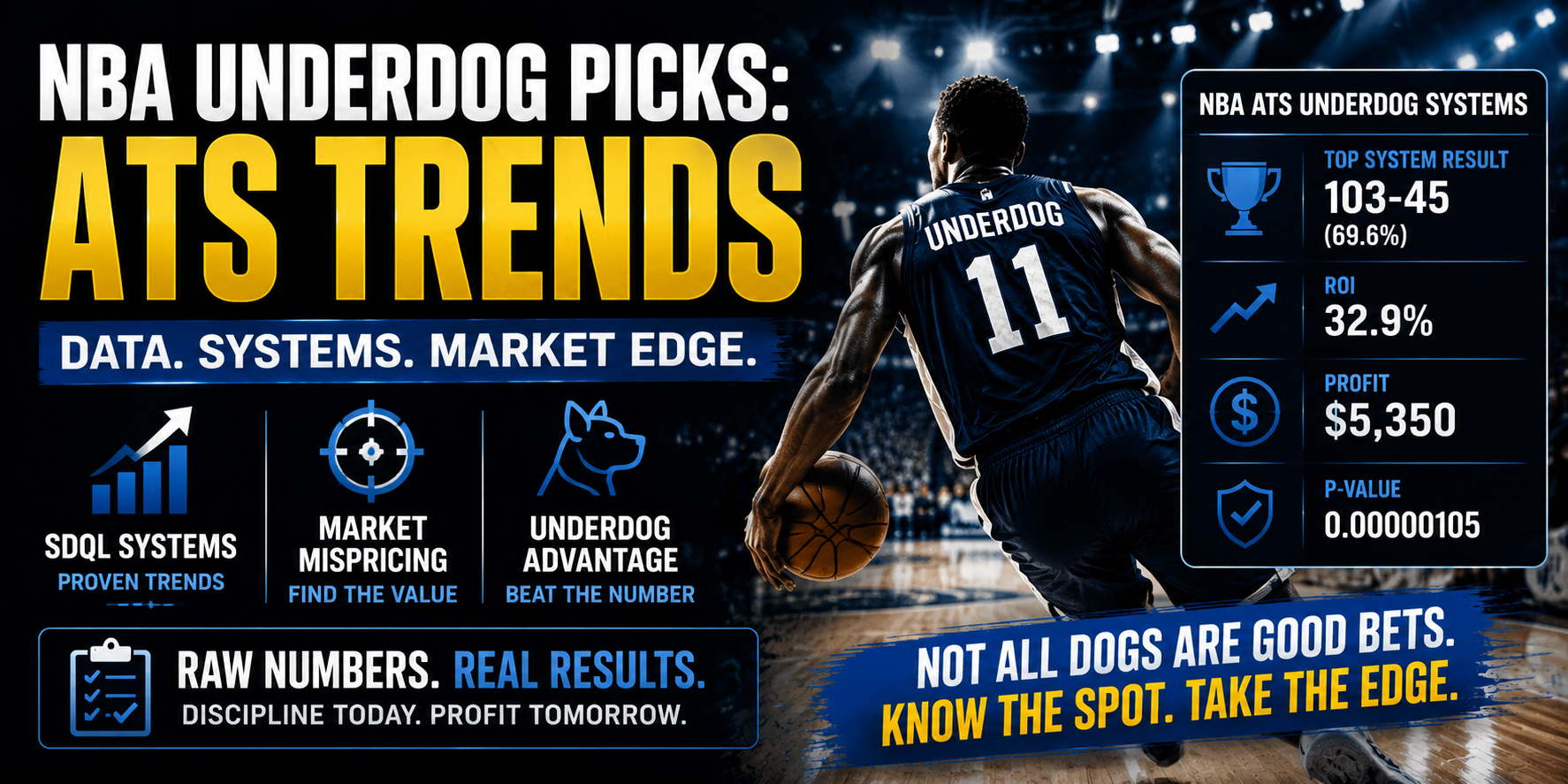
NBA underdog picks are popular because many bettors like getting points, but underdog value is not automatic. This article studies several SDQL-based NBA underdog systems showing when dogs may be overpriced, when they may be worth fading, and when the market may still leave value on the team taking points.
What Are These NBA Underdog Betting Trends?
These NBA underdog trends focus on spread range, turnover profile, team quality, ATS streaks, late-season form, and market perception. The goal is to separate useful underdog spots from dogs that only look attractive because they are getting points.
Many bettors believe underdogs are the sharper side by default.
That idea has some logic. Public bettors often prefer favorites. Sportsbooks may shade lines toward popular teams. Taking points can feel more comfortable than laying them.
But the market is more complicated than that.
Some underdogs are valuable. Some are traps. Some are priced correctly. Some should be faded because the points are not enough to compensate for the team’s underlying problems.
That is why NBA underdog picks need structure.
Featured NBA Underdog System: Fading Turnover-Damaged Dogs
This system focuses on underdogs between 3.5 and 9.5 points after an ugly turnover-margin profile. Historically, this has been one of the strongest underdog-related systems in the current NBA research file.
SDQL:D and 3.5<=line<=9.5 and p:turnovers-po:turnovers>=13
Betting Market:
Against the Spread
System Direction:
Fade the underdog profile / play against the dog side
Historical Results:
103-45
69.6%
32.9% ROI
$5,350 profit
P-value: 0.00000105
This system is important because it challenges the idea that every underdog with points is attractive.
The team is an underdog in a moderate spread range, but the previous turnover-margin profile is ugly. That suggests the dog may be coming out of a poor ball-security situation where the market has not fully adjusted for underlying weakness.
The record is strong, but the sample is smaller than some of the broader systems. That means it should be used as a high-signal filter, not a blind rule.
Why Some NBA Underdogs Should Be Faded
Some NBA underdogs should be faded because the points may not fully compensate for bad form, poor ball security, weak execution, or a market price that still overstates the team’s true competitiveness.
Taking points feels safe.
But points only matter if the number is large enough. A bad underdog can lose by more than the spread even when the line looks generous.
Turnovers are especially important because they can reveal deeper problems:
- Poor guard play
- Bad spacing
- Weak decision-making
- Defensive pressure vulnerability
- Transition points allowed
- Reduced shot volume
- Late-game execution problems
An underdog that is already weaker by market rating and also has a negative turnover profile can become dangerous to back.
That is the logic behind this fade-dog system.
How Should Bettors Read the SDQL Query?
The SDQL query identifies underdogs in a moderate spread range after a previous turnover-margin condition. It is not saying to fade all dogs, only a specific dog profile with ball-security concerns.
The query is:
D and 3.5<=line<=9.5 and p:turnovers-po:turnovers>=13
In plain English, this means:
- D = the team is an underdog
- 3.5<=line<=9.5 = the team is taking between 3.5 and 9.5 points
- p:turnovers-po>=13 = the previous turnover margin condition is heavily negative
That creates a very specific underdog fade profile.
The system is not based on team names, opinion, or recent media coverage. It is testing whether underdogs in this turnover-damaged situation have been overvalued by the market.
Historically, that profile has been worth fading.
What Do the Results Say?
The turnover-damaged underdog system has gone 103-45 against the spread, winning 69.6% with a 32.9% ROI and $5,350 in historical profit. The p-value of 0.00000105 makes it one of the strongest smaller-sample signals in the NBA file.
The key results:
- Record: 103-45
- Win Rate: 69.6%
- ROI: 32.9%
- Profit: $5,350
- P-value: 0.00000105
- Sample Size: 148 decisions
Those are excellent numbers, but the sample size matters.
A smaller sample can still be useful, especially with a clean basketball explanation, but it should not be treated the same way as a 2,000-game system. It is best used as a warning flag when an underdog looks attractive only because it is receiving points.
Supporting System: Sub-.500 Road Dogs With ATS Streak Context
Another NBA underdog system in the research file focuses on road underdogs with sub-.500 winning percentage, negative ATS streak context, opponent rest conditions, and opponent ATS momentum.
SDQL:AD and WP < 50 and (o:rest=0 or rest=1) and ats streak < 0 and 0 < o:ats streak < 3
Betting Market:
Against the Spread
System Direction:
Evaluate the road underdog profile ATS
Historical Results:
943-765
55.2%
5.4% ROI
$10,150 profit
This system is broader and more stable than the turnover-damaged dog system because it has a much larger sample.
The profile involves road underdogs with losing records and recent ATS weakness. On the surface, those teams can look unattractive. But the market may sometimes over-discount them, especially when the opponent is not in a clean rest or ATS situation.
This is where underdog betting becomes more nuanced.
Some bad-looking dogs are bad bets. Others may become valuable because the market has already punished them too heavily.
That is why Raw Numbers and current pricing matter.
Why Bad-Looking Dogs Can Still Have Value
Bad-looking dogs can still have value when the market overreacts to poor records, recent ATS losses, or public dislike. A weak team can cover if the spread is too high.
Underdog betting is not about finding good teams.
It is about finding mispriced teams.
A sub-.500 road underdog may have many flaws, but the sportsbook line is supposed to account for those flaws. If the market adjusts too far, the ugly dog can still hold value.
This is one of the hardest ideas for bettors to accept.
A team can be bad and still be a good bet. A team can be good and still be a bad bet. The spread is what matters.
That is why this broader road-dog system belongs in the article. It balances the first system by showing that not all ugly underdogs should be automatically faded.
Supporting System: Big April Dogs With Recent ATS Margin
A third underdog trend focuses on big dogs late in the season with strong recent ATS margin. This system studies situations where the market may still underrate a large underdog despite recent competitiveness.
SDQL:line>8 and tS(ats margin,N=3)>=18 and month=4
Betting Market:
Against the Spread
System Direction:
Evaluate the big underdog profile ATS
Historical Results:
139-79
63.8%
21.7% ROI
$5,210 profit
This is another smaller-sample system, but the logic is useful.
The team is getting more than eight points in April, and its recent three-game ATS margin profile is strong. In plain terms, the market is still pricing the team as a large underdog even though its recent spread performance has been much better than expected.
April adds another layer.
Late in the regular season, motivation, tanking, rest, seeding, and lineup changes can distort pricing. A big dog with recent ATS competitiveness may be more dangerous than the market assumes.
Why April Underdogs Require Extra Context
April underdogs require extra context because late-season NBA markets are shaped by motivation, rotation changes, playoff positioning, and teams with very different organizational incentives.
The NBA betting board changes late in the season.
Some teams are pushing for seeding. Some are managing injuries. Some are trying to avoid the play-in. Some are developing younger players. Some are eliminated and unpredictable.
That can create opportunity on both sides.
In the earlier April road favorite article, the focus was on favorites that may benefit from motivation and opponent weakness. In this article, the April big-dog system shows the other side: some large underdogs may still be undervalued when recent ATS performance suggests they are more competitive than the spread implies.
The lesson is not to blindly bet April dogs.
The lesson is to understand why April pricing can become less stable.
Supporting System: Cold Double-Digit Dogs Against Hot Teams
Another related underdog profile focuses on double-digit dogs with poor recent straight-up form facing opponents with strong recent straight-up form. This can create a classic perception gap.
SDQL:line>10 and tS(margin<0,N=10)>=8 and otS(margin>0,N=10)>=8
Betting Market:
Against the Spread
System Direction:
Evaluate the double-digit underdog profile ATS
Historical Results:
318-237
57.3%
9.4% ROI
$5,730 profit
This system is valuable because it captures a common market psychology setup.
One team looks cold. The opponent looks hot. The spread becomes large. Public bettors may prefer the stronger-looking side.
But large spreads can create underdog value if the gap between perception and price gets too wide.
A cold team does not need to win the game. It only needs to stay inside the number. If the market overprices the hot team’s recent form, the ugly double-digit dog can become attractive.
Why Hot vs Cold Perception Can Distort NBA Lines
Hot vs cold perception can distort NBA lines because bettors often extrapolate recent form too aggressively. A hot favorite can become overpriced, while a cold underdog may be discounted too heavily.
Recent results are easy to remember.
If one team has been winning and the other has been losing, bettors may assume the trend will continue. Sometimes it does. But the market usually adjusts quickly.
When a spread reaches double digits, the favorite has to do more than win. It has to win by margin.
That creates room for underdog value if the market has overreacted.
This is why double-digit NBA underdogs need careful review. They are not automatically good bets, but they can be valuable when the current price is too extreme.
How Raw Numbers Fit Into NBA Underdog Picks
Raw Numbers help determine whether the current spread gives the underdog enough value. Historical systems identify the profile, but the current number decides whether the pick is playable.
This is especially important with underdogs.
A dog may be valuable at +10.5 and unattractive at +7.5. A road underdog may look playable before injury news and become weak after a key player is ruled out. A fade-dog profile may be strong at one spread but lose value after the market moves.
When an NBA underdog system qualifies, the next questions should be:
- Does Raw Numbers support the dog or the fade side?
- Is the current spread still playable?
- Has the number already moved too far?
- Is the dog being overvalued because bettors want points?
- Is the favorite being overpriced because of recent form?
- Are injuries or rest changing the matchup?
- Does the market price still leave value?
That process keeps underdog betting from becoming automatic.
Raw Numbers
Daily market projections and betting data used to support data-driven sports betting picks.
When NBA Underdog Trends May Be Stronger
NBA underdog trends may be stronger when the current spread is inflated, public perception is leaning too heavily toward the favorite, Raw Numbers support the dog, and injury context does not weaken the underdog.
The strongest underdog setups usually include several signals:
- Qualifying SDQL system
- Raw Numbers support
- Enough points still available
- Market perception tilted toward the favorite
- No major injury issue against the dog
- Line movement has not removed value
- Spread range still fits the system logic
- The underdog has a plausible path to staying competitive
That last point matters.
An underdog does not need to be the better team, but it does need a reasonable path to covering the number.
When NBA Underdog Trends May Be Weaker
NBA underdog trends may be weaker when the dog has real matchup problems, the line has already moved too far, the injury report is negative, or the system is actually pointing toward fading the dog.
This is where many bettors make mistakes.
They find a reason to take the points and ignore the rest of the profile. But some underdogs are cheap for a reason. Some are priced correctly. Some are still overpriced even with the points.
Main risks include:
- Turnover-heavy underdogs
- Poor late-game execution
- Bad injury news
- Weak defensive matchups
- Line movement removing value
- Public dog betting
- Back-to-back fatigue
- Favorite matchup superiority
The first system in this article is a reminder that underdog betting cuts both ways. Sometimes the best underdog analysis leads to fading the dog.
Why This Matters for NBA ATS Picks
NBA ATS picks are about price, not preference. Underdogs only have value when the spread is too high, and favorites only have value when the spread is too low.
This is the main lesson of the article.
The dog label does not create value. The points do not create value by themselves. The value comes from the difference between the market number and the true expectation.
That can lead to different conclusions:
- Some dogs should be played.
- Some dogs should be passed.
- Some dogs should be faded.
- Some favorites are still worth laying.
- Some spreads are already efficient.
NBA underdog picks are strongest when they are handled through that kind of market-based framework.
How This Fits With NBA Picks Today
NBA underdog trends can support NBA picks today when a current matchup qualifies and the spread still agrees with Raw Numbers, injury context, market timing, and price discipline.
A practical workflow might look like this:
- Review the current NBA board
- Identify underdog profiles
- Compare the spread to Raw Numbers
- Check active SDQL systems
- Review opening line versus current line
- Evaluate injuries, rest, and lineup context
- Decide whether the dog, favorite, or pass is strongest
- Confirm whether the current number remains playable
That process prevents blind dog betting.
NBA Picks Today Backed by Raw Numbers
The main NBA picks hub explaining how Raw Numbers, SDQL systems, and market analysis fit together.
How This Compares to Other NBA ATS Trends
The earlier NBA ATS articles focused on favorites, road favorites, revenge spots, playoff systems, rest advantage, and April market timing. This article adds the underdog side of the ATS research silo.
Each article studies a different source of ATS value:
- Road favorites against opponents off close wins
- Favorites after embarrassing losses
- April road favorites late in the season
- Playoff favorites by series context
- Rest advantage spots after overtime wins
- Top-seed favorite profiles
- Underdog pricing and fade-dog profiles
Together, they create a more complete NBA picks framework.
NBA Favorite Picks: Top Seed ATS Betting Trends
A data-driven NBA favorite article focused on top seeds, elite-team profiles, and ATS value.
NBA Picks Against the Spread: Road Favorite Betting Trend
A data-driven NBA ATS system focused on road favorites facing opponents coming off close wins.
NBA Road Favorite Picks: April ATS Betting Trend
A data-driven NBA ATS article focused on April road favorites and late-season market conditions.
Related NBA Analysis
Use these NBA pages to connect this underdog betting article to the broader NBA betting research structure.
NBA Trends
NBA betting trends, systems, and historical market analysis.
NBA Team Trends
Team-specific NBA betting trends and market-based research.
NBA Raw Numbers Example
A closer look at how NBA Raw Numbers can be used to evaluate the betting board.
How This Fits Into the Market
NBA spreads are market prices. They move because sportsbooks, public bettors, professional bettors, injuries, recent form, team perception, and underdog/favorite bias all interact.
These supporting guides explain the broader market framework behind NBA underdog picks:
Sports Betting Market Mechanics
How line movement, timing, sharp money, and market pricing work.
Public Bias and Market Distortion
How public perception can distort betting prices and create value.
What Sports Betting Systems Really Measure
How systems should be used as market signals instead of isolated betting shortcuts.
Process & Proof
A serious NBA underdog betting process should be measurable over time. That is why ProComputerGambler emphasizes Raw Numbers, documented results, and long-term performance tracking.
Raw Numbers
Daily betting projections and market data used to support the picks process.
Historical Performance
Long-term documented results and performance transparency.
Sports Betting Picks Subscription
Member access to daily sports betting picks, Raw Numbers, and betting analysis.
Final Thoughts on NBA Underdog Picks
These NBA underdog systems are valuable because they show both sides of underdog betting. Sometimes the dog is worth playing because the market has overreacted. Sometimes the dog is worth fading because the points are not enough.
The label does not matter by itself.
What matters is the price.
A disciplined NBA underdog picks process should compare the spread to Raw Numbers, check historical system support, evaluate injuries and rest, and decide whether the current number still offers value.
That is the difference between taking points and making a data-driven NBA ATS decision.
