
MLB Totals Trends: When Over/Under Bias Creates Market Value

MLB totals betting is not just about predicting runs.
That is the mistake many bettors make. They look at starting pitchers, recent offense, bullpen fatigue, weather, park factors, and assume the goal is simply to decide whether a game will be high scoring or low scoring.
But totals betting is a market problem first.
The real question is not:
“Will this game have runs?”
The better question is:
“Has the market already priced the expected run environment correctly?”
That distinction matters because baseball totals are shaped by perception. Bettors react to recent scoring. They remember yesterday’s 11-8 game. They downgrade offenses after a 2-1 final. They see ace pitchers and assume Under. They see weak bullpens and assume Over.
But the market sees those things too.
This is why MLB totals should be analyzed through sports betting market mechanics, not just box scores.
This article looks at historical MLB totals data by closing total range and previous-game over/under margin. The goal is not to create a blind “bet Overs” or “bet Unders” rule. The goal is to understand when scoring expectations may become overpriced.
The strongest finding is this:
MLB scoring explosions are usually priced efficiently, but scoring disappointment may create more interesting Under continuation spots — especially when both teams are coming off games that stayed meaningfully Under the total.
That is a market lesson, not a hype angle.
MLB Totals Lean Under Overall — But That Alone Is Not Enough
Across the full MLB totals sample, Overs struggled.
The broad result is clear: blindly betting MLB Overs has historically been difficult.
But the Under side was not automatically profitable either. It simply lost less than the Over side.
That is an important distinction.
The correct conclusion is not:
“Always bet MLB Unders.”
The better conclusion is:
“MLB totals markets often make Overs expensive, but the Under still needs the right price and context.”
This is where most bettors oversimplify totals betting. They know the public tends to like Overs, so they assume every Under has value. That is not true.
Public preference is only one ingredient. A real edge requires market distortion, not just a common bettor tendency. For a deeper explanation, see Public Bias & Market Distortion in Sports Betting.
Closing Total Range Matters
A total of 7.5 is not the same market as a total of 10.
Lower totals imply a different scoring environment. The market is already expecting pitching strength, weak offense, run-suppressing weather, or a pitcher-friendly park. Higher totals imply the opposite: more expected offense, weaker pitching, bullpen risk, or a hitter-friendly environment.
The historical results show that MLB Overs had a harder time clearing lower totals.
The low-total result is especially notable.
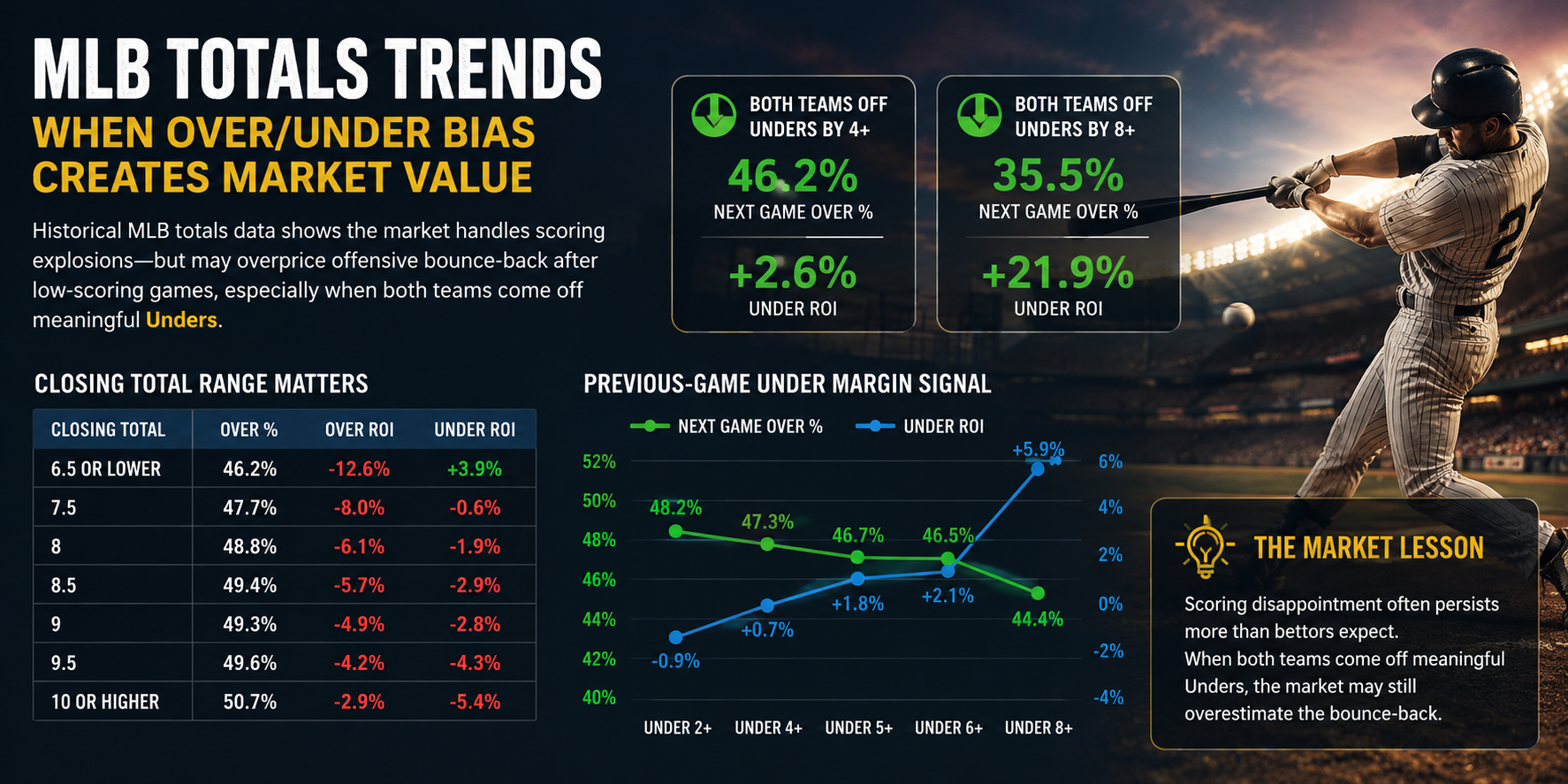
Games with totals of 6.5 or lower went only 46.2% Over, with the Under side showing +3.9% ROI.
That does not mean every low-total game should be bet Under. Low totals are dangerous because one crooked inning can ruin the bet. But historically, the market still appears to have had trouble making those games low enough.
At the other end, games with totals of 10 or higher went 50.7% Over, but Over ROI was still negative at -2.9%.
That is a useful reminder:
A higher win rate does not automatically mean profitable value. The price still matters.
For more on why small price differences can erase a betting edge, see Price Sensitivity in Sports Betting.
Previous-Game Overs: The Market Usually Handles Scoring Explosions
One of the most common totals instincts is to react to a recent scoring explosion.
If a team just played a game that went well Over the total, bettors may think:
- the offense is hot,
- the bullpen is vulnerable,
- the ball is carrying,
- or the team is in an Over-friendly stretch.
But recent scoring is visible information. The market sees it. Oddsmakers see it. Public bettors see it.
The data suggests that previous-game Overs did not create a strong next-game edge by themselves.
This is one of the most important lessons in the article.
A previous-game scoring explosion did not create a clear next-game Over continuation edge. It also did not create a powerful automatic Under correction.
The results mostly stayed close to normal MLB totals behavior.
That suggests the market handles obvious high-scoring results reasonably well.
The lesson:
A team coming off a high-scoring game is not hidden information. If the next total has already adjusted, there may be no value left.
This is also why historical systems should be treated as research, not automatic instructions. See How to Read SDQL Betting Systems Without Fooling Yourself.
Previous-Game Unders Are More Interesting
The opposite side produced a much stronger pattern.
When a team’s previous game stayed Under the total, the next game leaned Under more noticeably — especially as the prior Under became larger.
This is where the data becomes more actionable as a research concept.
After a previous-game Under by 4+ runs, the next game went only 47.3% Over, with Under ROI at +0.7%.
After a previous-game Under by 5+ runs, the next game went only 46.7% Over, with Under ROI at +1.8%.
After a previous-game Under by 6+ runs, the next game went only 46.5% Over, with Under ROI at +2.1%.
That does not mean every team off a low-scoring game should be blindly bet Under again. But it does challenge a common betting instinct.
Many bettors expect low-scoring games to bounce back.
The data suggests the opposite may be more interesting:
In MLB, scoring disappointment can persist more than bettors expect.
This is the type of result that belongs under a broader sports betting systems framework: the trend is not predicting the future by itself, but it may reveal how the market prices recent scoring disappointment.
Why Low-Scoring Games May Continue Under
There are several possible explanations.
A low-scoring game may reflect more than random failure. It can point to:
- weak offensive form,
- strong pitching matchups,
- pitcher-friendly conditions,
- suppressed park environment,
- poor lineup quality,
- bullpen strength,
- or a market total that was still too high.
The key is not that a team “forgot how to hit.” The key is that the previous low-scoring result may be a symptom of broader run-suppression conditions.
This is where market interpretation matters.
A bettor may see a 3-1 final and think:
“The offense is due.”
But the market question is:
“Was the previous low-scoring game random, or did it reveal a run environment the market has not fully adjusted to?”
The historical results suggest that meaningful previous-game Unders deserve attention.
Both Teams Coming Off Overs
The next step is to look at both teams.
If one team coming off an Over is visible, both teams coming off Overs should be even more visible. This is where public scoring expectations can build quickly.
Even when both teams came off Over games, the next game did not become a strong Over environment.
In fact, Overs still struggled.
This is a major market-bias lesson.
When both teams just played high-scoring games, the public may expect another offensive game. But the next total often already reflects that expectation.
The market is not asleep.
The lesson:
Obvious Over narratives are often already priced into MLB totals.
That does not mean the Under is automatically valuable, but it does mean bettors should be careful chasing recent scoring.
Both Teams Coming Off Unders
The strongest results came when both teams were coming off Under games.
This is the cleanest finding in the study.
When both teams were coming off previous-game Unders, the next game went only 48.1% Over.
When both teams were coming off games that stayed Under by 4+ runs, the next game went only 46.2% Over, with the Under showing +2.6% ROI.
The most extreme filter — both teams coming off games that stayed Under by 8+ runs — produced a very strong historical Under result:
130-236-20 to the Over, only 35.5% Over
That is a powerful backtest, but it should still be interpreted carefully. The sample is much smaller, and extreme filters always require caution.
The safer conclusion is not:
“Blindly bet every extreme double-Under spot.”
The better conclusion is:
“When both teams are coming off meaningful scoring disappointment, the market may still overestimate the bounce-back.”
That is a useful research lead.
The Market May Overprice Bounce-Back Scoring
The most important idea in this article is not just that Unders performed well in certain spots.
The bigger idea is that bettors may overestimate offensive bounce-back.
After a high-scoring game, the market seems to adjust reasonably well. The previous Over is obvious. Bettors saw the scoring. Oddsmakers saw the scoring. The next total often accounts for the possibility that the teams are in an offensive environment.
After a low-scoring game, however, bettors may be more likely to assume correction.
They may think:
- the bats will wake up,
- the team was unlucky,
- the offense is too good to stay quiet,
- or the previous game was just a one-off.
Sometimes that is true. But the historical data suggests that meaningful scoring disappointment often continues to matter.
This is where Over/Under bias becomes important.
The public does not only like Overs because Overs are fun. The public also likes the idea of offensive correction.
That can create value when the market total does not fall far enough.
Why This Is Not a Blind Under System
Even with strong Under-leaning results, discipline matters.
There are several reasons not to overstate the findings.
First, MLB totals are highly sensitive to price. A move from 8 to 7.5, or from 9 to 8.5, can change the value of the bet. A historical Under edge can disappear if the current number is already too low.
Second, previous-game results are not enough by themselves. They should be combined with current matchup context:
- starting pitchers,
- bullpen availability,
- weather,
- park factor,
- umpire tendencies,
- lineup quality,
- travel,
- and market movement.
Third, the strongest extreme filters have smaller samples. The double previous-game Under by 8+ result is impressive, but it should be treated as a research signal, not a guarantee.
Fourth, sportsbooks adapt. If a condition becomes widely known or heavily bet, the price can change.
The goal is not to find a magic rule.
The goal is to understand how scoring expectations interact with market price.
For a broader warning on overfitting and false confidence, see Why Betting Systems Fail.
Practical MLB Totals Framework
Based on this research, here is a practical way to think about MLB totals.
This framework is more useful than a simple “bet Under” rule.
MLB totals value comes from identifying when the market’s scoring expectation is wrong.
Sometimes that means fading inflated Over interest. Sometimes it means recognizing that a low-scoring environment is more persistent than bettors expect. Sometimes it means passing because the number has already moved.
Main Takeaways
The data supports several important conclusions.
First, MLB Overs have historically been difficult to profit from blindly. Across the full sample, Overs hit only 49.1%.
Second, low totals were especially difficult for Overs. Games with totals of 6.5 or lower went only 46.2% Over, with the Under showing positive ROI.
Third, previous-game Overs did not create a strong next-game signal. The market appears to handle obvious scoring explosions reasonably well.
Fourth, previous-game Unders were more interesting. The larger the previous Under margin, the stronger the next-game Under tendency became.
Fifth, the strongest pattern appeared when both teams were coming off meaningful Unders. When both teams had stayed Under by 4+ runs in their previous games, the next game went only 46.2% Over, with the Under showing +2.6% ROI.
The broader lesson is simple:
MLB totals value does not come from predicting runs in isolation. It comes from identifying when the market has mispriced scoring expectations.
That is the difference between betting a total and analyzing a totals market.
How This Fits Into the Market
This article is part of a larger framework for understanding how sports betting markets process price, public perception, and historical conditions.
Start here:
- Sports Betting Market Mechanics
- Public Bias and Market Distortion
- What Sports Betting Systems Really Measure
Process & Proof
ProComputerGambler focuses on structured market research, documented performance, and long-term betting discipline.
Continue with:
Related Analysis
- How to Read SDQL Betting Systems Without Fooling Yourself
- Price Sensitivity in Sports Betting
- Why Betting Systems Fail
