
WNBA Rebounding and Shot Volume Trends: What Possessions Reveal

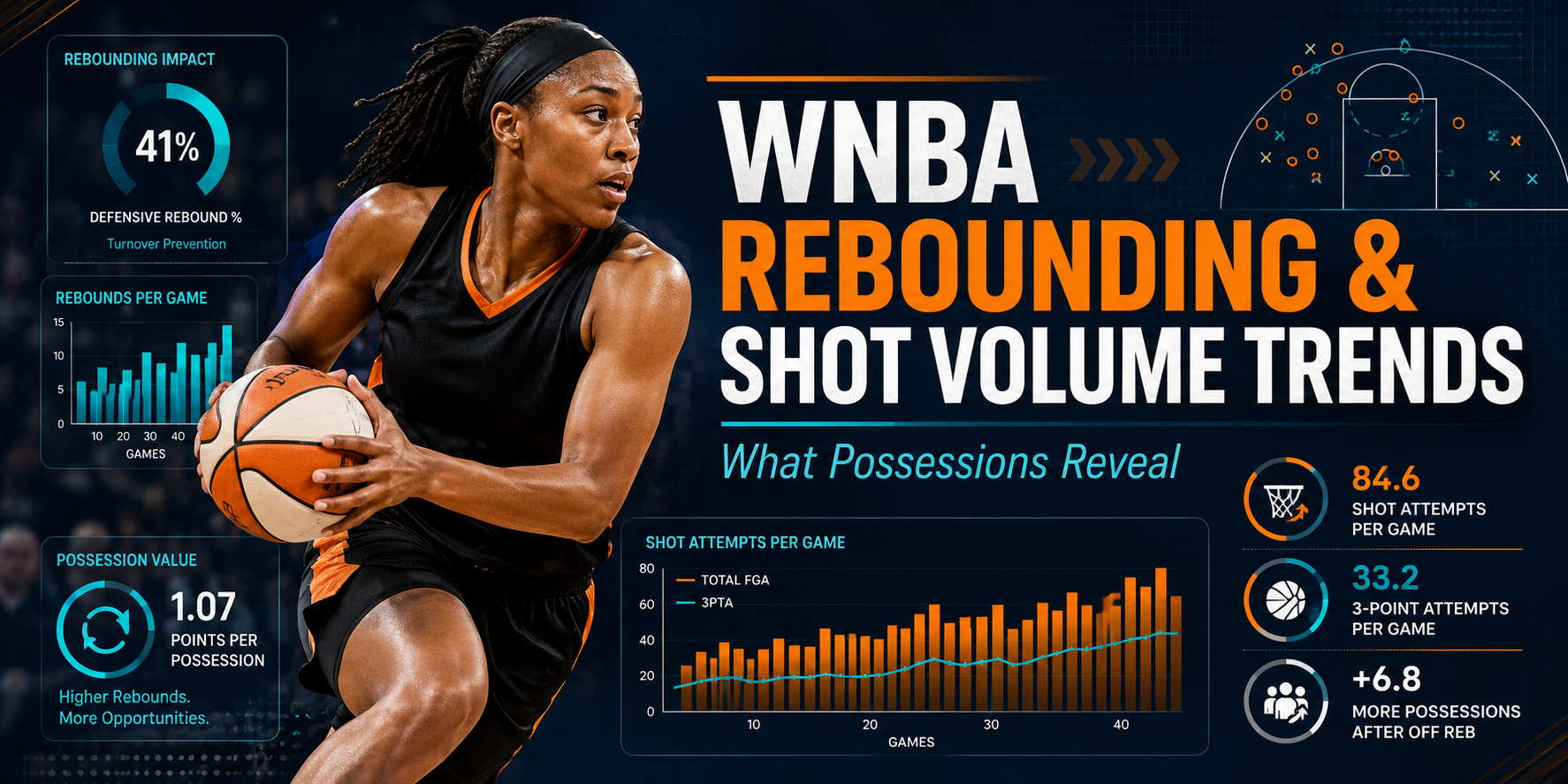
WNBA rebounding trends and shot volume trends can help explain why certain games go Over, stay Under, or create ATS value. Final scores tell us what happened. Rebounds, field goal attempts, offensive rebounds, three-point attempts, and pace-related conditions help explain how the game environment was created.
This article is part of the broader WNBA Betting Trends research library, covering historical ATS systems, totals systems, SDQL filters, and market-based WNBA betting analysis.
WNBA Rebounding and Shot Volume Trends Results Snapshot
These WNBA systems are historical market signals tied to possession volume, rebounding context, shot attempts, and spread or total pricing. They should not be treated as blind picks.
| Market | Play | Record | Win % | Units | ROI | P-Value | System Theme |
|---|---|---|---|---|---|---|---|
| O/U | OVER | 359-248 | 59.1% | +86.2 | 12.9% | 0.00000380 | Opponent defensive rebounding context with prior total margin |
| O/U | UNDER | 599-485 | 55.3% | +65.5 | 5.5% | 0.00029636 | Large-sample Under profile with offensive rebounds and block context |
| O/U | UNDER | 311-223 | 58.2% | +65.7 | 11.2% | 0.00008079 | Low field goal attempts, low rebounding, underdog profile |
| O/U | OVER | 292-209 | 58.3% | +62.1 | 11.3% | 0.00012080 | Higher field goal attempt profile from lower-win teams |
| ATS | ON | 205-135 | 60.3% | +56.5 | 15.1% | 0.00008703 | Positive-line teams with rebounding and pace context |
| ATS | ON | 298-219 | 57.6% | +57.1 | 10.0% | 0.00029485 | Teams catching 5.5+ after lower three-point volume |
Full SDQL References
For transparency, here are the full SDQL filters behind the systems above:
op:defensive rebounds<=24 and p:ou margin>-11.0 and tournament=0P:offensive rebounds<7 and playoffs=0 and po:blocks>2p:field goals attempted<=62 and D and p:rebounds<=33tournament=0 and WP<=50.0 and P:field goals attempted>=67season>=2022 and p:rebounds>=31 and line>=1.5 and op:pace>=81.6P:three pointers attempted<32 and line>=5.5 and tournament=0
Why Possession-Based WNBA Trends Matter
Possession-based WNBA trends matter because betting markets are not only pricing teams. They are pricing the expected number of scoring opportunities.
A team can be efficient but slow. A team can be inefficient but fast. A team can miss shots but create extra possessions through offensive rebounds. Another team can shoot well but generate too few attempts to push a game Over.
That is why final score alone is not enough.
Possession-based data helps answer better questions:
- How many shots were created?
- Were possessions extended by offensive rebounds?
- Did defensive rebounding end possessions cleanly?
- Was the prior scoring result supported by volume?
- Did the market overreact to efficiency while ignoring opportunity?
- Did the spread undervalue a team with enough rebounding support to compete?
Those are market questions, not hype questions.
Field Goal Attempts as a WNBA Betting Signal
Field goal attempts are one of the clearest possession indicators in basketball betting research. More attempts usually mean more scoring opportunities. Fewer attempts usually mean fewer chances to reach a total or cover a spread.
One of the strongest Under systems in this research is:
p:field goals attempted<=62 and D and p:rebounds<=33
This system went 311-223 to the Under, producing +65.7 units with an 11.2% ROI.
In plain English, this system focuses on underdogs coming off a game with low field goal attempts and low rebounding output.
That is a logical Under profile.
A team that recently generated 62 or fewer field goal attempts may have played at a slower pace, struggled to create shots, or operated in a lower-possession environment. If that same team also had no more than 33 rebounds, the possession profile becomes even more restrictive.
The market may see a normal total.
The underlying shot volume may point lower.
High Shot Volume Can Create WNBA Over Value
Field goal attempts can also support Over systems when the volume is high enough. One strong Over trend is:
tournament=0 and WP<=50.0 and P:field goals attempted>=67
This system went 292-209 to the Over, producing +62.1 units with an 11.3% ROI.
This system is interesting because it focuses on teams with a win percentage of 50% or lower after attempting at least 67 field goals in the previous game.
That matters because lower-win teams are not always respected by the market. Bettors may assume they are offensively limited or less likely to help a game reach the total. But high shot volume can tell a different story.
A team does not have to be elite to contribute to an Over.
It needs enough possessions, enough attempts, and enough offensive opportunity to make the posted total too low.
That is the key distinction.
Team quality and scoring opportunity are not the same thing.
Why Defensive Rebounds Matter for WNBA Totals
Defensive rebounds matter because they end possessions. When a team controls the defensive glass, it limits second chances and can suppress scoring. When defensive rebounding is weaker, possessions can extend, which can create more shots, more fouls, and more scoring pressure.
The strongest Over system in this group is:
op:defensive rebounds<=24 and p:ou margin>-11.0 and tournament=0
This system went 359-248 to the Over, producing +86.2 units with a 12.9% ROI.
The market idea is clear enough to explain.
If an opponent recently had 24 or fewer defensive rebounds, it may suggest that possessions were not being ended cleanly. When that context is paired with a prior total margin that was not deeply below expectation, the next game may have more scoring potential than the posted number reflects.
This does not mean defensive rebounds alone predict Overs.
They do not.
But defensive rebounding can help describe the possession environment that the market may be missing.
Why Offensive Rebounds Matter for WNBA Unders
Offensive rebounds extend possessions. They create second shots, extra fouls, kick-out threes, and additional scoring chances. When offensive rebounding is limited, missed shots are more likely to end possessions.
That is why offensive rebounding appears in a large-sample Under system:
P:offensive rebounds<7 and playoffs=0 and po:blocks>2
This system went 599-485 to the Under, producing +65.5 units.
The ROI is lower than some smaller trends, but the sample size is important. A 599-485 result is much more credible as a public research example than a tiny perfect-record angle.
In plain English, this system focuses on regular-season Under value tied to prior offensive rebounding and opponent block context.
The logic is not complicated.
If a team profile includes limited offensive rebounding, there may be fewer extended possessions. Fewer extended possessions can reduce total scoring pressure. If the market prices the game closer to average scoring expectations, the Under may become valuable.
Why Rebounding Also Matters Against the Spread
Rebounding does not only affect totals. It can also affect spread value.
One ATS system in this group is:
season>=2022 and p:rebounds>=31 and line>=1.5 and op:pace>=81.6
This system went 205-135 ATS, producing +56.5 units with a 15.1% ROI.
This system focuses on teams catching at least 1.5 points after recording at least 31 rebounds in the previous game, while facing an opponent with a pace profile of at least 81.6.
That is a useful ATS concept.
An underdog or positive-line team with rebounding support may be better positioned to stay competitive. Rebounding can prevent opponent runouts, create extra possessions, and help a team survive a faster game environment.
The market may price the team as an underdog.
The rebounding profile may suggest the team is more competitive than that price implies.
That is why possession-based research belongs in ATS analysis, not just totals analysis.
Three-Point Attempts and WNBA Spread Value
Shot volume is not only about total field goal attempts. Three-point attempt volume can also shape market perception.
One spread system in the database is:
P:three pointers attempted<32 and line>=5.5 and tournament=0
This system went 298-219 ATS, producing +57.1 units with a 10.0% ROI.
This system focuses on regular-season teams catching at least 5.5 points after attempting fewer than 32 three-pointers in the previous game.
The logic is subtle.
A team with lower three-point volume may not look explosive. Casual bettors may worry that the underdog lacks comeback ability or scoring upside. But if the market overreacts to that perception, the spread can become too generous.
This does not mean lower three-point volume is always good.
It means that in this specific historical spread range, the market may have discounted those teams too heavily.
Why Final Scores Can Mislead WNBA Bettors
Final scores are useful, but they can be misleading when they are separated from possession context.
A game can finish low-scoring because both teams played slowly. It can also finish low-scoring because both teams missed open shots. Those are different situations.
A game can finish high-scoring because the pace was fast. It can also finish high-scoring because shooting efficiency was unsustainably high. Those are also different situations.
That matters for betting.
If the market reacts to the final score without understanding how that score was created, the next line or total may be wrong.
Possession-based variables help separate repeatable conditions from noise.
For example:
- Field goal attempts help measure opportunity.
- Offensive rebounds help measure possession extension.
- Defensive rebounds help measure possession control.
- Three-point attempts help describe shot profile.
- Pace context helps explain scoring environment.
- Rebounding support can help underdogs stay inside the number.
The final score is the result.
Possession data helps explain the process.
How Rebounding and Shot Volume Connect ATS and Totals
One of the strongest reasons to study rebounding and shot volume is that they connect sides and totals.
A team with strong rebounding can help an underdog cover because it limits opponent second chances and creates extra possessions. That same rebounding profile can also affect the total by changing shot volume and possession length.
A team with high field goal attempts can support an Over, even if it is not a great team. A team with low field goal attempts and weak rebounding can support an Under, especially if the total does not fully account for the lack of possession volume.
This is why betting markets should not be studied in isolated boxes.
Sides and totals are connected through the game environment.
The spread prices margin.
The total prices scoring.
Possession data influences both.
Why These WNBA Trends Are Not Blind Picks
WNBA rebounding and shot volume trends should not be treated as automatic bets. A historical system can identify a useful market pattern, but the current price still matters.
For totals, the current number may already have moved. An Over system may be useful at 160.5 but weak at 165.5. An Under system may be useful at 174.5 but unplayable at 169.5.
For spreads, the same principle applies. A positive-line team may be valuable at +5.5 but not at +3.5.
The system identifies the type of situation.
The current line determines whether value still exists.
That is why every possession-based trend should be checked against current market conditions before it becomes part of a betting decision.
How to Use WNBA Possession Trends Responsibly
WNBA possession trends are best used as research filters. They can help identify games where the market may have mispriced scoring volume, spread value, or team competitiveness.
A disciplined process looks like this:
- Identify whether the game qualifies for a rebounding or shot-volume system.
- Read the SDQL in plain English.
- Determine whether the system points to ATS value, Over value, or Under value.
- Review the current line or total.
- Check whether the number has already moved.
- Review injuries, rest, lineup context, and pace.
- Decide whether the current price still reflects value.
The goal is not to bet every trend.
The goal is to understand whether the market has priced the possession environment correctly.
That is the disciplined way to use historical WNBA systems.
What Makes a WNBA Rebounding or Shot Volume Trend Website-Worthy?
A WNBA rebounding or shot-volume trend is website-worthy when it teaches something useful about how games are priced. The best examples are not just profitable. They explain the relationship between possessions and market value.
The strongest public-facing examples usually include:
- Meaningful sample size
- Positive units
- Reasonable ROI
- Low p-value
- Clear possession logic
- Rebounding or shot-volume context
- A connection to ATS value, Over value, or Under value
- A simple explanation that readers can understand
That is why systems like 359-248 Over, 599-485 Under, 311-223 Under, 292-209 Over, and 205-135 ATS are useful public examples.
They are not guarantees.
They are documented historical market signals.
WNBA Rebounding and Shot Volume Trends FAQ
What are WNBA rebounding trends?
WNBA rebounding trends are historical systems that study how rebounding conditions have affected ATS results, totals results, or broader market pricing.
Why do rebounds matter for WNBA betting?
Rebounds affect possession control. Offensive rebounds extend possessions, while defensive rebounds end them. That can influence scoring, pace, and spread value.
What are WNBA shot volume trends?
WNBA shot volume trends study field goal attempts, three-point attempts, and scoring opportunity. Shot volume can help explain whether a total is too high or too low.
Do field goal attempts predict Overs and Unders?
Field goal attempts do not predict totals by themselves, but they can help measure possession volume. Higher attempts can support Over profiles, while lower attempts can support Under profiles depending on the system.
Can rebounding help underdogs cover?
Yes, in some situations. Rebounding can help underdogs stay competitive by limiting opponent second chances and creating additional possessions.
Should I bet every WNBA rebounding system?
No. WNBA rebounding and shot-volume systems should be used as research signals. The current line, total, market movement, injuries, rest, and matchup context still matter.
How This Fits Into the Market
Sports Betting Market Mechanics
Understand how spreads, totals, line movement, and market pricing shape betting value.
Public Bias and Market Distortion
Learn how public perception can distort prices and create market-based opportunities.
What Sports Betting Systems Really Measure
See why historical systems should be treated as market signals, not guaranteed predictions.
Process & Proof
Historical Performance
Review long-term Raw Numbers and official daily email performance tracking.
Raw Numbers
Access daily Raw Numbers and market-based projections by sport.
Related WNBA Betting Research
WNBA Betting Trends
Start with the main WNBA betting trends hub covering ATS systems, totals systems, SDQL research, and market-based analysis.
WNBA Over/Under Trends
Study broader WNBA totals systems, including both Over and Under results tied to pace, rebounds, and scoring environment.
WNBA Over Betting Trends
Review Over-focused WNBA totals systems tied to shot volume, rebounding context, scoring pressure, and market under-adjustment.
WNBA Under Betting Trends
Review Under-focused WNBA totals systems tied to low-possession profiles, reduced shot volume, rest, and game-flow conditions.
WNBA Spread Betting Trends
See how possession structure, rebounds, and shot volume can also affect ATS value and point-spread pricing.

Possession math seems especially important in the WNBA because a few extra shots can completely change the spread or total result
In tighter markets and lower-possession games, small volume edges matter a lot more than most bettors realize
This feels more predictive than just saying a team shot badly last game and should bounce back
Right. A bad shooting night by itself can be noise, but strong rebounding and shot volume show the team was still generating opportunities
I like the focus on second-chance opportunities instead of just final score or field goal percentage
That’s the idea. Extra possessions create pressure even when the shots do not immediately fall, and the market does not always price that correctly
The possession-based angle is sharp because rebounding and shot volume tell a different story than shooting percentage
Shooting percentage can swing wildly, but extra possessions and shot attempts are more structural. That is why volume-based systems can be useful