
WNBA Underdog Betting Trends: Historical ATS Angles From the Database

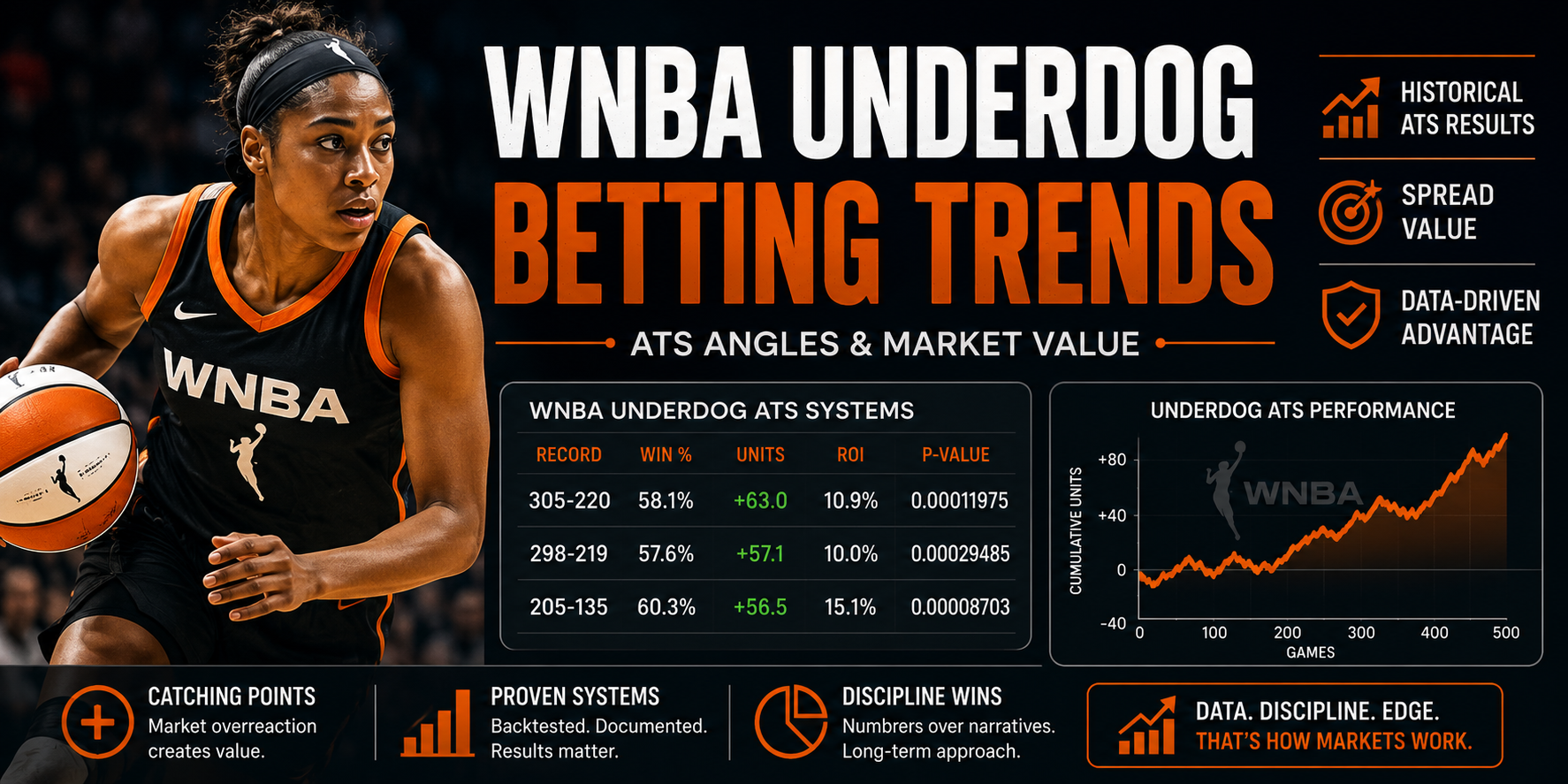
WNBA underdog betting trends are useful because they focus on one of the most uncomfortable parts of betting: taking points with teams the market may not want. Underdogs are not automatically valuable, but historical ATS systems can help identify situations where the spread may have moved too far against lower-profile teams.
This article is part of the broader WNBA Betting Trends research library, covering historical ATS systems, totals systems, SDQL filters, and market-based WNBA betting analysis.
WNBA Underdog Betting Trends Results Snapshot
These underdog systems are best understood as historical market signals. They are not blind picks. The most useful results combine sample size, positive units, ROI, and a clear spread-pricing explanation.
| Market | Play | Record | Win % | Units | ROI | P-Value | System Theme |
|---|---|---|---|---|---|---|---|
| ATS | ON | 305-220 | 58.1% | +63.0 | 10.9% | 0.00011975 | Regular-season underdogs catching 5.5+ |
| ATS | ON | 298-219 | 57.6% | +57.1 | 10.0% | 0.00029485 | Underdogs after lower three-point volume |
| ATS | ON | 205-135 | 60.3% | +56.5 | 15.1% | 0.00008703 | Positive-line teams with rebounding and pace context |
| ATS | ON | 399-297 | 57.3% | +72.3 | 9.4% | 0.00006288 | Away teams with non-inflated prior pricing |
| ATS | ON | 502-387 | 56.5% | +76.3 | 7.8% | 0.00006452 | Road-team value with prior ATS and defensive context |
Full SDQL References
For transparency, here are the full SDQL filters behind the systems above:
streak<=2 and line>=5.5 and tournament=0P:three pointers attempted<32 and line>=5.5 and tournament=0season>=2022 and p:rebounds>=31 and line>=1.5 and op:pace>=81.6site=away and p:line>=-5.5 and tournament=0season>=2017 and p:ats margin>=-22.0 and A and op:blocks<=3
What Are WNBA Underdog Betting Trends?
WNBA underdog betting trends measure how teams catching points have performed against the spread in specific historical situations. The goal is not to prove that underdogs are always better. The goal is to study when the market may have priced certain teams too pessimistically.
In spread betting, the underdog does not need to win the game outright. It only needs to perform better than the posted number. A team catching +6.5 can lose by six and still cover.
That makes underdog analysis different from normal team analysis.
The question is not:
“Is this team likely to win?”
The better question is:
“Is this team being given too many points?”
That is where historical WNBA ATS systems can help.
Why WNBA Underdogs Deserve Market Attention
WNBA underdogs deserve attention because betting markets are often shaped by perception. Casual bettors usually prefer favorites. Favorites feel safer. Favorites are easier to explain. Favorites often have better records, better recent form, or more recognizable players.
Underdogs usually require more discipline.
That discomfort can create value when the spread moves too far. If the market overprices the favorite or over-discounts the underdog, the points can become more valuable than the team’s public reputation suggests.
This is especially important in smaller markets like the WNBA. Public discussion is thinner, pricing attention may be less consistent than in larger sports, and team narratives can lag behind actual performance.
That does not mean every WNBA underdog is a good bet.
It means certain underdog profiles deserve structured research.
The Strongest WNBA Underdog ATS System
One of the strongest underdog systems in this group is:
streak<=2 and line>=5.5 and tournament=0
This system went 305-220 ATS, producing +63.0 units with a 10.9% ROI.
In plain English, this looks at regular-season teams catching at least 5.5 points when their current streak is no more than two games.
That is a useful market profile because it avoids teams that are already on long public-friendly streaks. It focuses instead on underdogs that may not have strong narrative momentum but are still receiving a meaningful number.
The key idea is simple.
A team catching 5.5 or more does not have to be great. It only has to be more competitive than the market expects.
That is the foundation of underdog betting.
Why Catching 5.5 or More Matters
The 5.5-point threshold matters because it represents a meaningful spread cushion. In basketball, a few possessions can decide whether a team covers. When the market gives an underdog 5.5 or more, the bettor is not just betting on the team. The bettor is betting on the price.
That price can matter more than the matchup opinion.
A favorite may be better, but if the spread is inflated, the underdog can still be the correct side. This is where inexperienced bettors often get uncomfortable. They confuse “better team” with “better bet.”
Those are not the same thing.
The system:
streak<=2 and line>=5.5 and tournament=0
does not say that underdogs are superior teams. It says that this class of underdogs has historically covered more often than the market implied.
That is a pricing statement.
Not a prediction statement.
Underdogs After Lower Three-Point Volume
Another strong underdog system is:
P:three pointers attempted<32 and line>=5.5 and tournament=0
This system went 298-219 ATS, producing +57.1 units with a 10.0% ROI.
This trend is interesting because it combines underdog pricing with previous-game shot profile. It looks at teams catching at least 5.5 points after attempting fewer than 32 three-pointers in the previous matchup.
At first, lower three-point volume may not seem like an obvious underdog angle. But from a market perspective, it can matter.
A team that did not rely heavily on threes in its previous game may be perceived as less explosive. Casual bettors may prefer the favorite if the underdog does not look like it has enough scoring upside. But if the market overreacts to that lower-perimeter profile, the underdog can still hold ATS value.
The system does not mean fewer threes automatically create value.
It means that in this specific historical underdog profile, the spread may have been too generous.
Positive-Line Teams With Rebounding and Pace Context
The system:
season>=2022 and p:rebounds>=31 and line>=1.5 and op:pace>=81.6
went 205-135 ATS, producing +56.5 units with a 15.1% ROI.
This is a more recent system, beginning in 2022, and it focuses on teams catching at least 1.5 points with prior rebounding context and opponent pace context.
This is useful because it does not rely only on the spread. It adds basketball logic.
Rebounding can help an underdog stay inside the number by creating extra possessions, limiting second chances, and reducing opponent scoring runs. Opponent pace can also affect the spread environment because faster games create more possessions, more variance, and more opportunities for an underdog to keep the margin within range.
That makes this system more than a generic “take the points” angle.
It suggests a specific profile: positive-line teams with enough rebounding support to compete in a faster game environment.
Why WNBA Underdogs Can Be Emotionally Difficult to Bet
Underdogs are difficult because they often look wrong. The favorite may have the better record. The favorite may have the better star player. The favorite may be at home. The favorite may have won more recently.
But betting is not about comfort.
It is about price.
A good underdog bet often feels uncomfortable because the market has already built the negative story into the number. The bettor is not saying the underdog is clearly better. The bettor is saying the spread may be too high.
That distinction is important for WNBA betting research.
If a team is catching +7.5, the market has already acknowledged that the team is weaker. The question is whether +7.5 is too much.
Historical underdog systems help frame that question with data instead of emotion.
How Road-Team Trends Connect to Underdog Value
Not every road team is an underdog, and not every underdog is on the road. But there is overlap between the two ideas because road teams are often less attractive to the market.
That is why some of the stronger WNBA ATS systems include away-team conditions.
For example:
site=away and p:line>=-5.5 and tournament=0
This system went 399-297 ATS, producing +72.3 units.
This is not a pure underdog-only system, but it supports the same market idea. It focuses on ordinary regular-season away teams that were not coming from inflated prior pricing.
Another broader road-team value system is:
season>=2017 and p:ats margin>=-22.0 and A and op:blocks<=3
This system went 502-387 ATS, producing +76.3 units.
These road-team systems reinforce the underdog concept because the market often discounts uncomfortable teams. Road status, lower scoring profiles, weak recent narratives, and positive-line pricing can all work together to create ATS value.
Why Underdog Trends Are Not Blind Picks
WNBA underdog trends should not be treated as automatic plays. A profitable historical system can still be a poor current bet if the number is gone.
This is especially true with underdogs.
A team may be valuable at +7.5 but not at +5.5. A system may still technically qualify, but the price may no longer justify the risk. The difference of two points can matter a lot in spread betting.
That is why the current line must always be checked.
Important questions include:
- What is the current spread?
- Did the line move toward or away from the underdog?
- Is the underdog still catching enough points?
- Are injuries affecting the true number?
- Has the favorite become overpriced?
- Has the market already corrected the value?
The historical trend identifies the situation.
The current market price determines whether the situation is still playable.
How to Use WNBA Underdog Betting Trends Responsibly
A disciplined underdog process should use trends as filters, not final answers. The system can point toward a possible pricing error, but the bettor still has to evaluate the current market.
A practical process looks like this:
- Identify whether the underdog qualifies for a historical ATS system.
- Review the current spread.
- Compare the current number to the system’s historical logic.
- Check injury, rest, and lineup context.
- Review whether the market has already moved.
- Decide whether the underdog is still catching enough points.
- Track closing line value over time.
The point is not to bet more underdogs.
The point is to understand when underdogs may be priced incorrectly.
That is the difference between disciplined market research and blindly fading favorites.
What Makes a WNBA Underdog Trend Website-Worthy?
A WNBA underdog trend is website-worthy when it explains a real market concept. The best examples are not just impressive records. They show why a type of team may have been mispriced.
The strongest public-facing underdog trends usually have:
- A meaningful sample size
- Positive units
- Reasonable ROI
- A low p-value
- Clear spread logic
- A simple market explanation
- A connection to underdog pricing, public discomfort, or team context
That is why larger trends like 305-220 ATS, 298-219 ATS, and 205-135 ATS are better public examples than tiny perfect-record angles.
The goal is not to make the trend look magical.
The goal is to make the market logic clear.
WNBA Underdog Betting Trends FAQ
What are WNBA underdog betting trends?
WNBA underdog betting trends are historical systems that study how teams catching points have performed against the spread in specific situations.
Does an underdog have to win the game?
No. An underdog can cover the spread by losing by fewer points than the posted number or by winning outright.
Are WNBA underdogs profitable?
Some historical WNBA underdog systems have produced profitable ATS records, but underdogs are not automatically profitable. The value depends on the exact spread, system conditions, and market timing.
Why do bettors like favorites more than underdogs?
Favorites feel safer because they are expected to win the game. But the favorite is not always the better bet if the spread is inflated.
Why does line value matter with underdogs?
Line value matters because an underdog at +7.5 is not the same as the same underdog at +5.5. If the number moves too far, the historical edge may disappear.
Should I bet every WNBA underdog system?
No. WNBA underdog systems should be used as research filters. The current line, injuries, market movement, and matchup context still matter.
How This Fits Into the Market
Sports Betting Market Mechanics
Understand how spread pricing, market timing, and line movement shape betting value.
Public Bias and Market Distortion
Learn how public preference for favorites can create pricing errors and market distortion.
What Sports Betting Systems Really Measure
See why historical systems should be treated as market signals, not guaranteed predictions.
Process & Proof
Historical Performance
Review long-term Raw Numbers and official daily email performance tracking.
Raw Numbers
Access daily Raw Numbers and market-based projections by sport.
Related WNBA Betting Research
WNBA Betting Trends
Start with the main WNBA betting trends hub covering ATS systems, totals systems, SDQL research, and market-based analysis.
WNBA ATS Trends
Review broader WNBA against-the-spread systems focused on road teams, underdogs, spread value, and market pricing.
WNBA Spread Betting Trends
Study WNBA spread systems focused on line ranges, ATS value, and why price matters more than team labels.
WNBA Road Team ATS Trends
Review road-team ATS research focused on away pricing, public discomfort, and historical spread value.

WNBA underdogs seem strongest when the market is reacting to reputation instead of current pricing
That’s the key. Underdog value usually comes from perception gaps, not just from taking points blindly