
WNBA Road Team ATS Trends: Why Away Pricing Deserves Attention

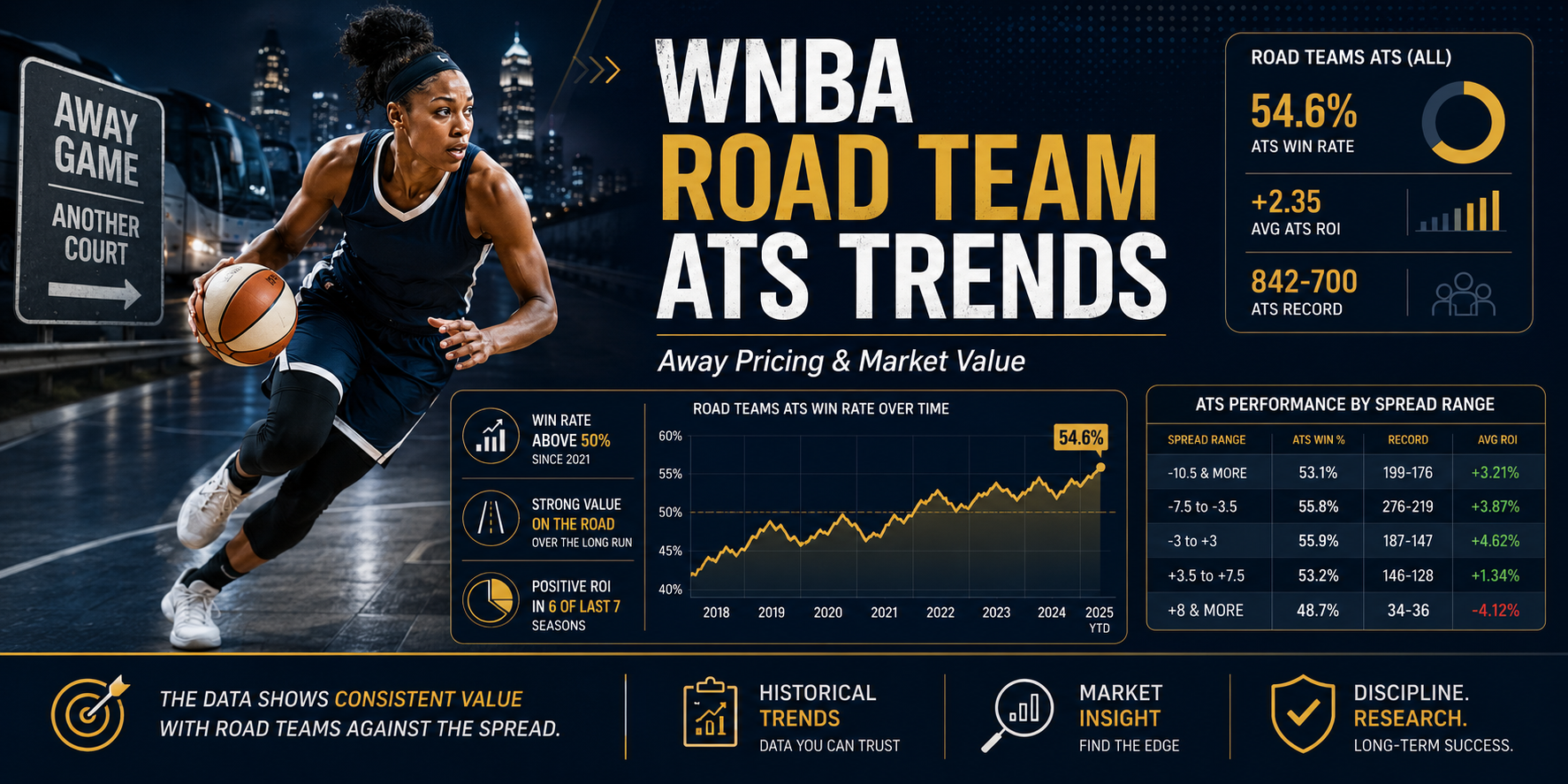
WNBA road team ATS trends are useful because they focus on one of the most important parts of betting market analysis: price. Road teams are often less attractive to casual bettors, especially when they have lower scoring profiles, recent losses, or limited public attention. That creates a research opportunity when historical data shows that certain away-team profiles have covered the spread more often than expected.
This article is part of the broader WNBA Betting Trends research library, covering historical ATS systems, totals systems, SDQL filters, and market-based WNBA betting analysis.
WNBA Road Team ATS Trends Results Snapshot
The strongest WNBA road-team systems in this research are not based on one small sample or one recent season. Several of the better ATS systems include away-team conditions across hundreds of historical games.
| Market | Play | Record | Win % | Units | ROI | P-Value | System Theme |
|---|---|---|---|---|---|---|---|
| ATS | ON | 464-335 | 58.1% | +95.5 | 10.9% | 0.00000285 | Away team, opponent block context, lower scoring profile |
| ATS | ON | 502-387 | 56.5% | +76.3 | 7.8% | 0.00006452 | Away team, prior ATS margin, opponent block context |
| ATS | ON | 399-297 | 57.3% | +72.3 | 9.4% | 0.00006288 | Regular-season away team pricing |
| ATS | ON | 286-213 | 57.3% | +51.7 | 9.4% | 0.00062306 | Away team, prior foul control |
| ATS | ON | 297-222 | 57.2% | +52.8 | 9.2% | 0.00057073 | Away team, short streak, recent performance context |
| ATS | ON | 205-135 | 60.3% | +56.5 | 15.1% | 0.00008703 | Underdog/positive-line profile with pace and rebounding context |
Full SDQL References
For transparency, here are the full SDQL filters behind the road-team systems above:
season>=2022 and p:rebounds>=31 and line>=1.5 and op:pace>=81.6season>=2017 and op:blocks<=3 and A and tA(points)<87.0season>=2017 and p:ats margin>=-22.0 and A and op:blocks<=3site=away and p:line>=-5.5 and tournament=0season>=2017 and P:fouls<20 and A and tournament=0season>=2022 and streak<=1 and A and P:dps>=-4.0
These are historical systems. They are not automatic betting instructions. The purpose is to study whether WNBA road teams have been undervalued in specific market conditions.
What Are WNBA Road Team ATS Trends?
WNBA road team ATS trends measure how away teams have performed against the spread in specific historical situations. A road team can lose the game outright and still cover the spread if the market price was too pessimistic.
That distinction is important.
Road team ATS research is not about saying road teams are “better” than home teams. It is about asking whether the market has historically discounted certain road teams too heavily.
A team can be average, unpopular, lower-scoring, or coming off an unimpressive result and still have spread value if the number is inflated against it.
That is why road-team trends are valuable from a market perspective.
They force the bettor to think in terms of price, not preference.
Why WNBA Road Teams May Be Mispriced
WNBA road teams can be mispriced for several reasons. The league receives less mainstream betting attention than larger markets, and casual bettors often prefer the cleaner story: home team, better record, favorite, star player, recent win.
Road teams often have the opposite profile.
They may be dealing with travel, weaker public perception, lower scoring averages, or recent poor results. Those factors make them uncomfortable to bet. But uncomfortable teams are often where market value begins.
The question is not:
“Do I want to bet this road team?”
The better question is:
“Has the market discounted this road team too much?”
That is the logic behind studying WNBA road team ATS trends.
A spread is not a prediction of who will win. It is a price. If the market pushes that price too far because the road team looks unattractive, the away side may become valuable against the number.
The Strongest WNBA Road Team ATS System
The strongest road-team system in this group is:
season>=2017 and op:blocks<=3 and A and tA(points)<87.0
This system went 464-335 ATS, producing +95.5 units with a 10.9% ROI.
In plain English, this system looks at road teams since 2017 when the opponent had no more than three blocks in its previous game and the team’s average points profile was below 87.
The surface-level interpretation is simple: these are not necessarily high-powered, public-friendly road teams. They are away teams with more modest scoring profiles. That matters because the market may be less willing to respect them.
The opponent block filter may also point toward defensive context. If the opponent did not show strong interior disruption in the previous game, the road team may have been more competitive offensively than the spread implied.
The key takeaway is not that every low-scoring road team should be bet.
The takeaway is that certain lower-profile road teams have historically covered the spread at a strong rate when the market may have priced them too negatively.
A Cleaner Away-Team Pricing Trend
One of the cleanest road-team systems in the database is:
site=away and p:line>=-5.5 and tournament=0
This system went 399-297 ATS, producing +72.3 units with a 9.4% ROI.
This trend is especially useful for public-facing analysis because the concept is easier to explain. It focuses on regular-season road teams whose previous line was not an extreme favorite profile.
In other words, this system is not chasing elite teams or obvious public sides. It is isolating more ordinary away teams in regular-season conditions.
That makes it more valuable as an educational example.
The system suggests that the WNBA market may have historically undervalued road teams that were not coming from inflated favorite expectations. These teams may not look exciting, but they have been priced in a way that created ATS value.
That is the core principle behind road-team spread research.
The team does not need to be impressive.
The number needs to be wrong.
Road Teams After Rough ATS Results
Another strong road-team system is:
season>=2017 and p:ats margin>=-22.0 and A and op:blocks<=3
This system went 502-387 ATS, producing +76.3 units with a 7.8% ROI.
This is a larger-sample trend with a slightly lower ROI than the 464-335 system, but the sample size makes it important. The trend includes road teams whose previous ATS margin was not worse than -22 points, paired again with opponent block context.
The important part is that this system avoids teams coming off extreme ATS collapses while still focusing on road teams that may not be popular.
That is a useful market filter.
A road team coming off an ugly result can be toxic from a public betting perspective. But if the previous result was not a complete disaster and the opponent profile fits, the market may still over-discount the away side.
This is how historical betting systems help separate broad narratives from measurable conditions.
The narrative says road teams are dangerous.
The data asks which road teams have been mispriced.
Why Lower-Scoring Road Teams Can Still Have Value
One of the mistakes casual bettors make is assuming that lower-scoring teams are automatically bad spread bets. That is not always true.
Against the spread, a lower-scoring team can be valuable if the market already prices in its offensive limitations. In some cases, the market may overprice those limitations.
That appears to be part of the logic behind:
season>=2017 and op:blocks<=3 and A and tA(points)<87.0
A team averaging fewer than 87 points is not usually the kind of team casual bettors rush to back on the road. But that reluctance is exactly what can create value.
Spread betting is not about liking the team.
It is about evaluating whether the line reflects the true probability of covering.
A lower-scoring road team may still cover if:
- The opponent is overpriced.
- The spread is inflated.
- The road team’s offensive limitations are already baked into the line.
- The matchup is more competitive than public perception suggests.
- The market overreacted to recent scoring or defensive results.
That is why WNBA road-team ATS trends deserve more attention than simple win-loss analysis.
Why Foul and Defensive Context Matter for Road Teams
Another road-team system from the database is:
season>=2017 and P:fouls<20 and A and tournament=0
This system went 286-213 ATS, producing +51.7 units with a 9.4% ROI.
This trend adds previous-game foul context. In plain English, it looks at regular-season road teams after a game where the team had fewer than 20 fouls.
That may indicate a more controlled game environment, fewer defensive breakdowns, or a team profile that did not rely on overly physical play. When that type of team goes on the road, the market may not fully price in the stability.
This is not a claim that fouls alone predict the next ATS result. They do not.
But foul context can be part of a broader team-control profile. When combined with away status and regular-season filtering, it becomes a useful historical signal.
Road teams are often judged by location first.
A good system looks deeper.
Why Recent Streaks Matter in Road-Team ATS Research
The system:
season>=2022 and streak<=1 and A and P:dps>=-4.0
went 297-222 ATS, producing +52.8 units with a 9.2% ROI.
This system focuses on road teams since 2022 with a current streak of one or less and a prior defensive-performance-style filter.
The logic is interesting because it avoids teams on extended winning streaks. That matters because long winning streaks can attract public attention and inflate market price. A road team with little or no streak is usually less appealing.
That can be useful.
Markets often price teams differently when they are hot, popular, or narrative-friendly. Road teams without strong recent momentum may be easier to overlook, especially in a league where public attention is already thinner.
The system suggests that lower-momentum road teams have still produced ATS value under certain conditions.
Again, the lesson is price.
Not popularity.
Why Road Team ATS Trends Are Not Blind Picks
WNBA road team ATS trends should not be treated as automatic picks. A system can identify a historical pricing pattern, but the current spread still determines whether value exists.
For example, a road team may qualify for a strong ATS system at +6.5. But if the market moves to +4.5, the value may be reduced or gone. The same historical trend can be useful at one number and unplayable at another.
That is why road-team trends should always be filtered through current market conditions.
Important checks include:
- What is the current spread?
- Has the number already moved?
- Is the road team catching enough points?
- Are injuries or rest changing the true price?
- Is the market correcting the historical inefficiency?
- Does the current matchup fit the logic of the system?
The trend tells you where to look.
The current number tells you whether the bet still makes sense.
How to Use WNBA Road Team ATS Trends Responsibly
A disciplined road-team ATS process should start with the historical system, but it should not end there.
A practical process would look like this:
- Identify whether the road team qualifies for a historical ATS system.
- Review the current spread.
- Compare the current number to the system’s historical range.
- Check injuries, travel, rest, and lineup context.
- Review whether the market has already moved.
- Evaluate whether the road team is being discounted too heavily.
- Track the closing line to judge the quality of the price.
The goal is not to bet every WNBA road team.
The goal is to identify situations where the market may have created too much of a home-team premium or too much road-team discount.
That is a market-based process.
It is very different from guessing which team will play better tonight.
What Makes a WNBA Road Team Trend Website-Worthy?
A WNBA road-team ATS trend is website-worthy when it combines statistical strength with a clear market explanation.
The best public-facing trends usually have:
- A meaningful sample size
- Positive units
- Reasonable ROI
- A low p-value
- A clear road-team condition
- A logical pricing explanation
- Enough simplicity that readers can understand the angle
That is why larger road-team systems like 464-335 ATS, 502-387 ATS, and 399-297 ATS are better public examples than tiny perfect-record trends.
They are not as sensational.
But they are more credible.
For a site built around documentation, discipline, and long-term market analysis, credibility matters more than shock value.
WNBA Road Team ATS Trends FAQ
What are WNBA road team ATS trends?
WNBA road team ATS trends are historical betting systems that measure how away teams performed against the spread in specific situations.
Does ATS mean the road team has to win?
No. ATS means against the spread. A road team can lose the game outright and still cover if it loses by fewer points than the spread.
Are WNBA road teams profitable against the spread?
Some historical WNBA road-team systems have produced profitable ATS records, but that does not mean all road teams are profitable. The value depends on the exact system, spread, market timing, and current context.
Why might WNBA road teams be undervalued?
Road teams can be less attractive to public bettors because of travel, weaker perception, lower scoring profiles, or recent poor results. If the market overreacts to those concerns, ATS value can appear.
Should I bet every WNBA road team that qualifies for a system?
No. These trends should be treated as research signals. The current spread, injuries, market movement, and closing line value still matter.
What is the best way to use road team ATS systems?
The best use is as a filtering tool. A road-team system can identify games worth studying, but the final decision should depend on price, matchup context, injury news, and market movement.
How This Fits Into the Market
Sports Betting Market Mechanics
Understand how spreads, market timing, line movement, and pricing shape betting value.
Public Bias and Market Distortion
Learn how public perception can create market distortion and pricing errors.
What Sports Betting Systems Really Measure
See why historical systems should be viewed as market signals, not guaranteed predictions.
Process & Proof
Historical Performance
Review long-term Raw Numbers and official daily email performance tracking.
Raw Numbers
Access daily Raw Numbers and market-based projections by sport.
Related WNBA Betting Research
WNBA Betting Trends
Start with the main WNBA betting trends hub covering ATS systems, totals systems, SDQL research, and market-based analysis.
WNBA ATS Trends
Review broader WNBA against-the-spread systems focused on road teams, underdogs, spread value, and market pricing.
WNBA Underdog Betting Trends
Study WNBA underdog systems and why uncomfortable positive-line teams can create ATS value.
WNBA Spread Betting Trends
Go deeper into point-spread ranges, line value, and why the number matters more than team labels.
