
WNBA Betting Systems: How to Read SDQL, ROI, Units, and P-Value

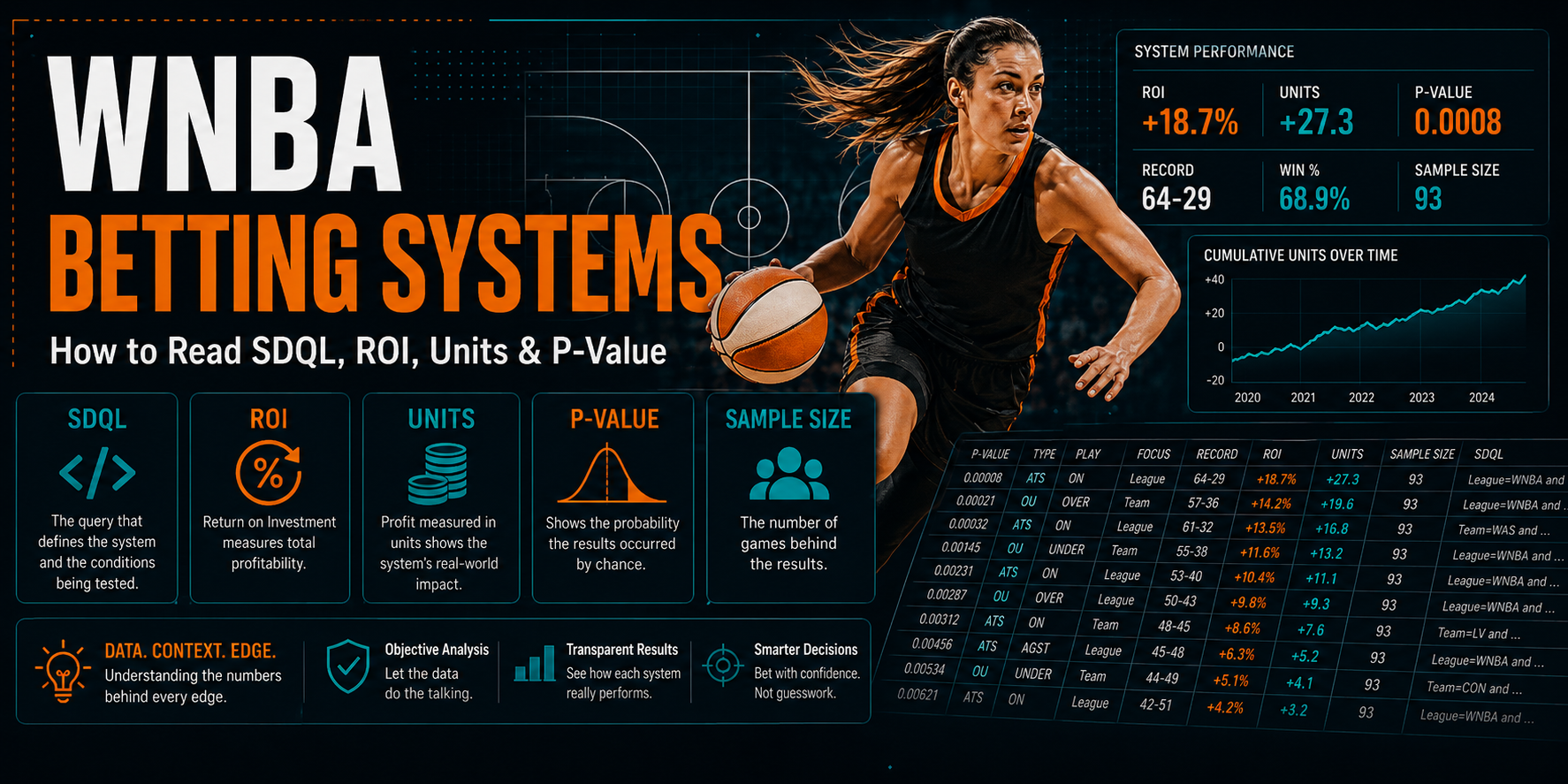
WNBA betting systems can be useful research tools, but only when the numbers are understood correctly. A profitable historical trend is not automatically a prediction. Record, ROI, units, p-value, sample size, and SDQL logic all need to be read together before a system can be treated as a serious market signal.
This article is part of the broader WNBA Betting Trends research library, covering historical ATS systems, totals systems, SDQL filters, and market-based WNBA betting analysis.
What Are WNBA Betting Systems?
WNBA betting systems are rule-based historical filters used to test how specific game situations performed against the spread, on totals, or in other betting markets. They are not meant to replace judgment. They are meant to organize market research.
A system might ask whether road teams have been undervalued, whether underdogs have covered in certain spread ranges, or whether totals have gone Over or Under after specific shot-volume or rebounding conditions.
That structure matters because it turns betting research into a repeatable process.
Instead of saying, “I like this team tonight,” a system asks:
Has this type of situation historically produced value against the market?
That is a much better question.
WNBA Betting Systems Results Snapshot
Here are several examples of WNBA betting systems used throughout this research cluster. The table is intentionally compressed so the main performance numbers are easier to read.
| Market | Play | Record | Win % | Units | ROI | P-Value | System Theme |
|---|---|---|---|---|---|---|---|
| ATS | ON | 464-335 | 58.1% | +95.5 | 10.9% | 0.00000285 | Away team, opponent block context, lower scoring profile |
| O/U | OVER | 359-248 | 59.1% | +86.2 | 12.9% | 0.00000380 | Defensive rebounding context with prior total margin |
| ATS | ON | 399-297 | 57.3% | +72.3 | 9.4% | 0.00006288 | Regular-season away team pricing |
| O/U | UNDER | 599-485 | 55.3% | +65.5 | 5.5% | 0.00029636 | Large-sample Under profile with rebounding and block context |
| O/U | UNDER | 311-223 | 58.2% | +65.7 | 11.2% | 0.00008079 | Underdog profile after low shot volume and low rebounding |
| ATS | ON | 305-220 | 58.1% | +63.0 | 10.9% | 0.00011975 | Regular-season underdogs catching 5.5+ |
| O/U | OVER | 210-134 | 61.0% | +62.6 | 16.5% | 0.00002466 | Prior Over result with positive prior margin |
Full SDQL References
For transparency, here are the full SDQL filters behind the systems above:
season>=2017 and op:blocks<=3 and A and tA(points)<87.0op:defensive rebounds<=24 and p:ou margin>-11.0 and tournament=0site=away and p:line>=-5.5 and tournament=0P:offensive rebounds<7 and playoffs=0 and po:blocks>2p:field goals attempted<=62 and D and p:rebounds<=33streak<=2 and line>=5.5 and tournament=0P:ou margin>=5.5 and p:margin>1 and tournament=0
What Is SDQL?
SDQL stands for Sports Data Query Language. It is a way to search historical sports databases using specific conditions. Those conditions can include season, site, line, total, previous-game statistics, team performance, opponent statistics, rest, streaks, and other measurable factors.
In plain English, SDQL lets a bettor ask very specific historical questions.
For example:
site=away and p:line>=-5.5 and tournament=0
This system looks at away teams in regular-season conditions when the team’s previous line was -5.5 or higher. Instead of relying on a general idea like “road teams have value,” SDQL lets the database test a narrower version of that idea.
That is the main value of SDQL.
It turns a betting theory into a measurable historical test.
How to Read a WNBA SDQL System
A WNBA SDQL system should be read in two layers: the code layer and the market-logic layer. The code tells you what was tested. The market logic tells you why the test might matter.
Take this example:
streak<=2 and line>=5.5 and tournament=0
The code means the system is looking at regular-season teams catching at least 5.5 points when their current streak is no more than two games.
The market idea is more important than the code itself.
This system is really asking whether non-streaking regular-season underdogs catching a meaningful number have historically been undervalued against the spread.
That is the translation process every system needs.
A system is not strong just because the SDQL looks complicated. In many cases, a simpler system with a clear market explanation is more useful than a complicated one that no one can explain.
Why Record Alone Is Not Enough
Record is usually the first number people notice, but it should not be the only number they trust. A 16-1 system may look amazing, but the sample is tiny. A 599-485 system may look less exciting, but it has been tested across far more games.
That distinction matters.
A betting system’s record answers one question:
How often did this situation win historically?
But it does not answer several other important questions:
- Was the sample large enough?
- Was the result profitable after price?
- Was the ROI meaningful?
- Was the p-value strong?
- Was the system overfit?
- Does the logic make market sense?
- Is the current line still playable?
That is why record must be read alongside units, ROI, sample size, and p-value.
A strong record with weak logic is dangerous.
A slightly less dramatic record with strong logic and a large sample may be much more useful.
What Units Mean in WNBA Betting Systems
Units measure betting profit or loss in standardized betting increments. Instead of focusing on dollars, units allow systems to be compared more consistently.
For example, a system showing +95.5 units means it produced 95.5 units of historical profit under the grading assumptions used in the database.
That matters because win percentage alone can be misleading.
A system can win more than 50% and still lose money if the pricing is bad. Another system can win at a lower rate and still be profitable if the odds or spread structure support it.
For WNBA ATS and totals systems, units help show whether the historical result translated into actual betting value.
The question is not just:
“How many games did it win?”
The better question is:
“Did the system beat the market after price?”
Units help answer that.
What ROI Means in WNBA Betting Systems
ROI stands for return on investment. It measures profit relative to the amount risked. In betting system research, ROI helps show how efficiently a system turned risk into historical profit.
For example, a system with a 10.9% ROI means the historical result produced a 10.9% return on the amount risked under the grading assumptions used.
ROI is useful because it helps compare systems with different sample sizes.
A smaller system may show a high ROI, while a larger system may show a lower ROI but stronger long-term credibility. Neither number should be read alone.
For example:
- 210-134 Over, +62.6 units, 16.5% ROI is strong and efficient.
- 599-485 Under, +65.5 units, 5.5% ROI is lower ROI but much larger sample.
Both can be useful, but they tell different stories.
The smaller system may be more powerful but more fragile.
The larger system may be less explosive but more stable.
What P-Value Means in Betting Systems
P-value is a statistical measure that helps estimate whether a result may be meaningful or could have occurred by chance. A lower p-value generally suggests the result is less likely to be random.
That does not mean a low p-value guarantees future profit.
It does not.
A low p-value only says that the historical result is statistically notable under the assumptions of the test. It does not prove that the market inefficiency still exists, that the system is not overfit, or that the current number is playable.
That is why p-value should be treated as one layer of evidence.
A strong system should ideally have:
- A meaningful sample size
- Positive units
- Reasonable ROI
- A low p-value
- Clear market logic
- Filters that are not overly tortured
- A reason the market may have mispriced the situation
P-value helps, but it is not magic.
Why Sample Size Matters So Much
Sample size is one of the biggest differences between serious betting research and hype-driven trend posting. A small sample can look spectacular by accident. A large sample is harder to fake.
That does not mean every large sample is automatically useful. A huge system with weak ROI or vague logic may still be unhelpful. But all else equal, larger samples deserve more respect than tiny perfect records.
For public website content, larger samples are especially important because they build trust.
A trend like 464-335 ATS or 599-485 Under may not be as flashy as a 12-0 trend, but it is more credible as market research.
Small samples can still be useful inside a research dashboard.
They just need to be treated differently.
A tiny system is a watch-list signal.
A large system with strong logic is closer to a public research example.
Why Complicated SDQL Systems Can Be Dangerous
A complicated SDQL system can look sophisticated, but complexity can also hide overfitting. Overfitting happens when a system is built too tightly around past results and loses predictive value going forward.
This is one of the biggest dangers in betting-system research.
If a system uses too many narrow filters, it may not be identifying a real market pattern. It may simply be describing a historical accident.
A good WNBA betting system should usually have a clear explanation.
For example, this system is easy to understand:
site=away and p:line>=-5.5 and tournament=0
It points toward regular-season away-team pricing.
This system is more complex:
season>=2017 and op:blocks<=3 and A and tA(points)<87.0
But it still has a possible market explanation: lower-scoring road teams against opponents with modest recent block output may have been undervalued.
The more complicated a system gets, the more important the explanation becomes.
Complexity is acceptable only when the market logic remains clear.
What Makes a WNBA Betting System Website-Worthy?
A WNBA betting system is website-worthy when it teaches something useful about the market. It should not just look profitable. It should help explain where a price, spread, or total may have historically been wrong.
The best public systems usually have:
- Strong sample size
- Positive units
- Solid ROI
- Low p-value
- Clear market concept
- Reasonable SDQL structure
- A connection to spread pricing, totals pricing, road teams, underdogs, shot volume, rebounds, or market perception
This is why not every system in a database belongs on a public page.
Some systems are better kept inside a member dashboard or private research process. Others are strong enough, simple enough, and logical enough to become educational examples.
That distinction protects credibility.
It also keeps the site positioned around documented research instead of hype.
How WNBA Betting Systems Should Be Used
WNBA betting systems should be used as research filters, not automatic betting triggers. A system can identify a historical pricing pattern, but the current market still determines whether value exists.
The most disciplined process looks like this:
- Identify whether a game qualifies for a historical system.
- Read the SDQL in plain English.
- Confirm the system has sample size, units, ROI, and p-value support.
- Check whether the logic makes market sense.
- Review the current spread or total.
- Check injury, rest, lineup, and market movement context.
- Avoid forcing the bet if the number has already moved.
The system tells you where to look.
The current price tells you whether there is still value.
That is the difference between using betting systems as research and using them as shortcuts.
Why WNBA Systems Fit a Market-Based Betting Process
WNBA systems fit a market-based betting process because they shift attention away from predictions and toward pricing. Instead of asking which team is “better,” systems ask whether the betting market has historically mispriced a situation.
That is the more useful question.
A road team may not be better than the home team, but it may be undervalued. An underdog may not win outright, but it may be catching too many points. A total may look low, but the possession profile may still point Over.
This is why WNBA betting systems are valuable as research tools.
They force the bettor to think in terms of market behavior, not personal opinion.
That fits the broader ProComputerGambler approach: documentation, discipline, long-term testing, and data over hype.
WNBA Betting Systems FAQ
What are WNBA betting systems?
WNBA betting systems are rule-based historical filters that test how specific WNBA game situations performed against the betting market.
What does SDQL mean?
SDQL stands for Sports Data Query Language. It is used to search historical sports data using specific conditions such as line, total, site, prior statistics, rest, streaks, and team context.
Are WNBA betting systems the same as picks?
No. A system is a historical research signal. A pick is a current-game recommendation. Systems should help identify situations worth studying, not replace current market analysis.
What is ROI in a betting system?
ROI measures return on investment. It shows how much historical profit a system produced relative to the amount risked.
What does p-value mean in betting systems?
P-value helps estimate whether a historical result may be statistically meaningful. A low p-value can strengthen a system, but it does not guarantee future profit.
Should I bet every qualifying WNBA system?
No. Qualifying systems should be reviewed against the current spread or total, line movement, injuries, rest, and market timing.
How This Fits Into the Market
Sports Betting Market Mechanics
Understand how line movement, pricing, market timing, and betting value work across sports markets.
Public Bias and Market Distortion
Learn how public perception can distort prices and create market-based betting opportunities.
What Sports Betting Systems Really Measure
See why historical systems should be treated as market signals, not prediction machines.
Process & Proof
Historical Performance
Review long-term Raw Numbers and official daily email performance tracking.
Raw Numbers
Access daily Raw Numbers and market-based projections by sport.
Related WNBA Betting Research
WNBA Betting Trends
Start with the main WNBA betting trends hub covering ATS systems, totals systems, SDQL research, and market-based analysis.
WNBA ATS Trends
Review broader WNBA against-the-spread systems focused on road teams, underdogs, spread value, and market pricing.
WNBA Over/Under Trends
Study broader WNBA totals systems, including both Over and Under results tied to pace, rebounds, and scoring environment.
What Sports Betting Systems Really Measure
Learn why historical systems should be treated as market signals, not prediction machines.

The p-value explanation is helpful because ROI by itself can look better than it really is
ROI shows what happened, but p-value helps measure whether the result is likely meaningful or just random variance